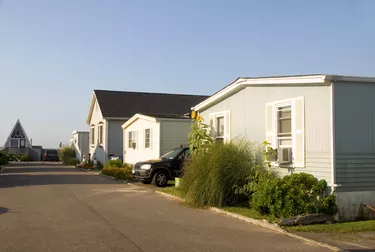
How to Finance a Mobile Home With Land
Newly built mobile homes have vehicle identification numbers and are classified as vehicles rather than homes. Consequently, lending options for mobile homes are more limited than for conventional homes because like all vehicles, mobile homes eventually become obsolete and therefore lose value over time. However, land prices tend to increase over long periods of time and if you attach your mobile home to permanent foundations then you can more easily finance it since the land will hold its value even if the home does not. You can obtain financing for a mobile home and land parcel from a bank or credit union.
Instructions
-
-
1
Contact local credit unions to see if you are eligible for membership. As nonprofit, member-owned institutions, credit unions typically offer lower interest rates on loans than banks. Find out which credit unions and banks offer mobile home and land financing, as not all institutions finance these properties.
-
2
Submit a preliminary loan application at three institutions that offer financing for mobile homes and land. You must consent for the lenders to check your credit report as a lender cannot offer you a rate on a loan without having first checked your credit report. Each of the lenders must provide you with a good-faith-estimate, or GFE, within three days of your application. The GFE shows you the interest rate, closing costs and payment terms.
-
-
3
Review the terms and conditions offered by each institution and determine the total cost of the loans by adding the total cost of the payments to the upfront closing costs. If you can afford to pay discount points to pay down your rate you can reduce your interest rate over the long term. But do not agree to pay upfront points that do not result in a true savings when compared with the other lenders' terms. Decide which loan option best suits your needs in terms of payment, closing costs and overall expense.
-
4
Provide the lender that offered the best overall terms with 60 days of bank statements, your most recent pay stub, two years' of W2's, the deed for your home, your homeowners insurance information and two years of tax returns if you are self-employed. Having reviewed this information your lender can lock your rate and complete the loan process. If the lender changes the terms or rejects the application, then contact the other lenders that provided you with GFEs and proceed with your application through another lender.
-
1
Tips & Warnings
Many lenders offer financing for mobile home and land packages, in the shape of loans that are backed by the Federal Housing Administration. The FHA finances home and land parcels for up to $92,904 in most parts of the country. But in some areas with a high cost of living you can borrow up to 85 percent of your property's value even if that amount exceeds the $92,904 limit. You need to have a credit score of 620 or higher to get a FHA-backed loan, although some lenders require higher scores.
The FHA does not insure loans on homes that were built prior to June 15, 1976, as inferior building codes were in place at that time. Additionally, the FHA does not insure loans on homes that have a living area of less than 400 square feet. You can shop around for a non-FHA backed loan if your home does not meet FHA standards. But most lenders impose tougher underwriting standards than the FHA. Those that do offer lending with more relaxed guidelines than the FHA tend to charge very high interest rates and significant closing costs. Lenders cannot assess prepayment penalties on FHA loans but lenders can with other products and many do with high-risk loans such as loans on older mobile homes.