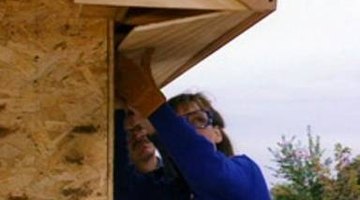
Vinyl Soffit & Facia Installation
Covering eaves with vinyl paneling can be cost effective and requires little maintenance. The vinyl can be cleaned relatively simply with a garden hose and does not need to be painted periodically. A vinyl soffit provides the wood underneath with protection from damaging weather conditions while providing an architectural decor that many homeowners prefer. Manufacturers produce a wide variety of designs and colors to match the needs of almost any homeowner. Does this Spark an idea?
Things You'll Need
- Galvanized roofing nails
- Utility trim
- Tape measure
- Trim coil
- Tin snips
- Metal break
- Colored trim nails
- Utility knife
- J-channel
- F-channel
- Double lineal channel
Instructions
-
Install Trim Coil
-
1
Attach the utility trim -- specific thinner vinyl trim used in place of other channeling -- at the top of the outside of the fascia board just under the extended roofing. Attach it down its entire length, using galvanized roofing nails. Leave it ¼ inch short to allow for expansion and contraction. Use a tape measure to check the height of the fascia board -- the vertical board capping the rafters -- from the inside of the utility trim.
-
2
Cut off a 4-inch strip of trim coil -- thin metal used for trimming around windows, doors and fascia boards -- for the corners, using tin snips. Cut the trim coil the height of the fascia board. Using a metal break, which is a specific tool used for breaking and bending trim coil, bend the trim coil in half at 90 degrees. Insert the trim coil into the utility trim and face nail it with colored trim nails. Snip off any excess trim coil hanging below the fascia.
-
-
3
Add 1¾ inches to the height of the fascia measurement, if the soffit is going to sit level with the outside of the fascia. Score the trim coil on the break with the utility knife and break the trim coil at that width. Make the first bend to the inside of the unfinished face of the trim coil ¾ inch from the edge. Bend the trim coil completely flat. Mark 1 inch from that bend and bend the trim coil in the same direction to a 90-degree angle.
-
4
Insert the trim coil into the utility trim and face nail the trim coil to the fascia with colored trim nails, overlapping each piece 1 to 2 inches while covering the length of the fascia board. Fully overlap the trim coil on the corners.
Soffit Installation
-
5
Install nailing strips down the length of the eaves where the fascia and eaves meet and where the wall and enclosed eaves meet, if the eaves are wider than 24 inches and it is not a high wind location. Install additional nailing strips no wider than 12 to 16 inches apart, extending down the full length of the eaves. If the eaves are open, additional framing may be necessary to support the nailing strips. Nailing a 2-by-4 down the length of the eaves against the vertical wall at the same level as the bottom of the nailing strip by the fascia will provide adequate support for channeling on open eaves. Framing with 2-by-4s between the wall and fascia board can also be nailed in open eaves to support nailing strips that go down the length of the eaves parallel to the vertical wall. Ensure all the nailing strips are level with each other.
-
6
Install J-channel or F-channel (J-shaped and F-shaped vinyl channels, respectively) along the eaves with roofing nails. Use the channel that is appropriate for placing the chosen level of the soffit. Collectively, any channels used for soffit installation are referred to as insertion channels. For soffit that runs even with the fascia board, the installed trim coil provides the insertion channel on the fascia board. Generally, F-channel will be nailed on the vertical surface of the wall on open eaves level with the channel by the fascia board. J-channel is nailed to the horizontal surface of the bottom of the rafters where they meet the fascia board on soffits that sit higher than the fascia board. J-channel is also installed in the corner where the eaves and the wall meet on enclosed eaves. Overlap all channels by one inch.
-
7
Measure the distance between the wall corner and fascia board corner for turning corners. Cut a double channel lineal (insertion channel with channeling on each side that looks like two J-channels placed back-to-back) ¼ inch shorter than the measurement, for expansion and contraction. Miter cut both ends of the channel and install. If the eave ends at a wall or roof line, install insertion channel (F-channel with open eaves and no framing, or J-channel with enclosed eaves or framing) with a mitered corner that overlaps the ends of the insertion channels on the wall and on the fascia board.
-
8
Measure the distance between the insertion channels. Cut the soffit panels ¼ inch smaller than the measurement taken. Nail the soffit panel through the center of the slots of the nail hem. Install the next soffit panel by snapping in the butt lock to the top lock and nailing it to the framing, nailing strips or enclosed eaves. Pop the last soffit panel into the insertion channeling at the end of the eaves or the double lineal channel on the corner.
-
1
Tips & Warnings
Use a can of spray paint the color of the trim coil to cover up and scratches caused during the installation.
Use colored caulking in corners and other areas to provide an additional protection against weather.
Pre-drill holes for face nailing trim nails to prevent putting dings in the trim coil.
A skill saw or miter saw with a reverse blade can be used to cut vinyl paneling and channels.
Nail vinyl paneling and channels tight enough to hold the vinyl but loose enough to allow it to move, to prevent buckling from expansion and contraction.
References
- Photo Credit Jupiterimages/Comstock/Getty Images