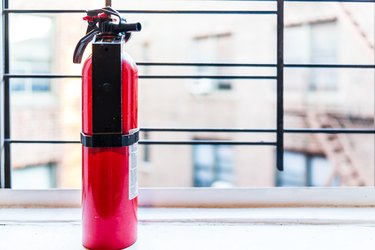
Even if you work to create a fire-resistant home, you still need certain gear in your home in case of a fire, including the right kind of fire extinguisher. For ease-of-use and optimum overall utility, the best fire extinguisher for the average home is one that displays 3-A; 40-B; C on the label. You might not know what these numbers and letters mean, but after becoming familiar with fire extinguisher classifications, you'll find them easy to understand. The ideal home fire extinguisher is one that can put out wood, grease, oil and electrical fires, and one that is lightweight enough for anyone to operate easily.
Tip
The best fire extinguisher for a home is lightweight and can handle class A, B and C fires. A common rating for home fire extinguishers is 3-A; 40-B; C.
Video of the Day
Commonly Named Fire Extinguishers
Two fire extinguishers often cited as ideal choices for home use are the First Alert Pro5 and the harder-to-find Amerex B402. Both exceed size recommendations of the National Fire Association without being unwieldy, and both fire extinguishers are reusable since they're refillable. Of the two, the First Alert Pro5 should be first on most shopping lists, because it's easy to find. It's available at any big box or hardware store, whereas the Amerex B402 is primarily available online. For smaller areas, good options include the First Alert Home1 or the Amerex B417.
Video of the Day
Fire Extinguisher Classifications
When shopping for a fire extinguisher, you'll find the types of fires it can put out listed on the label. The fire extinguisher classifications are as follows:
- Class A: Paper, wood and fabric fires
- Class B: Oil, grease and gasoline fires
- Class C: Electrical fires
- Class D: Flammable metal fires
- Class K: Animal and vegetable oil fires
Class D and K fire extinguishers are intended for factories and commercial kitchens and aren't normally used around the home, although it isn't a bad idea to keep a Class K extinguisher in the kitchen to put out oil fires. In general, a good multi-use fire extinguisher for home use is rated for Class A, B and C fires.
Additional Label Information
In addition, the label also identifies the amount of extinguishing material in the device as well as the maximum size of the fire that the device can handle. The number before the "A" specifies the amount of material as a multiple of 1.25 gallons of water, while the number before the "B" specifies the effective coverage area in square feet. There is no number before the "C," because that classification merely specifies that the extinguishing material won't conduct electricity.
The two extinguishers identified as ideal for home use bear the designation 3-A; 40-B; C, which means that the tank contains non-conducting extinguishing material equivalent of 3.75 gallons of water that can cover a maximum area of 40 square feet. A smaller fire extinguisher that would be more appropriate for automotive use would be rated something like 1-B; C. It isn't a Class A fire extinguisher since wood and paper fires are not likely to occur in a car.
When buying a fire extinguisher for your garage, on the other hand, you need one that's rated for larger fires. Because wood and cloth fires can and do occur in a garage, the typical rating is 4-A; 80-B; C, which means it has the extinguishing power of 5 gallons of water and covers an area of 80 square feet. It's heavier and a bit more difficult to handle than the model you should keep in your house.
What's in a Fire Extinguisher?
Water obviously extinguishes wood fires, and there may be water in some class A fire extinguishers, but water is ineffective against Class B and C fires and may even make them worse. Home-use fire extinguishers typically contain pressurized carbon dioxide gas or a chemical, such as sodium or potassium bicarbonate, that releases CO2 on contact with the air or the propellant in the cylinder. They may also contain a class of chemicals called hydrofluorocarbons (HFCs).
If you have a fire extinguisher around the house that is more than 20 years old, it could contain a halon gas. Halons, like chlorofluorocarbons, have been banned because of the damage they do to the earth's ozone layer. You should trade in your older fire extinguisher for a more recent fire extinguisher model.
How to Use Fire Extinguishers
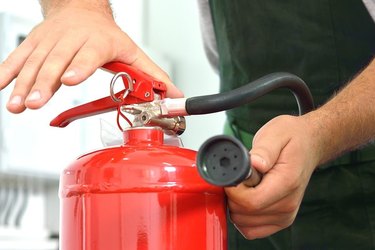
Fire extinguishers are designed to be easy to use, but when a fire occurs, you have to think and act fast, so it's good to be familiar with the procedure beforehand. The acronym PASS can help you remember all you need to know.
- P: Pull the pin to unlock the trigger. It usually has a round metal ring on it to make it easy to identify and easy to pull.
- A: Aim the fire extinguisher at the base of the flames. Make sure to keep a safe distance. If the label doesn't specify the minimum distance, assume it to be 6 feet.
- S: Squeeze the trigger. Hold it in and keep the cylinder upright as the fire extinguisher discharges.
- S: Sweep the nozzle of the extinguisher over the base of the flames, moving from side to side, until the cylinder runs dry.
No matter what active chemical your fire extinguisher contains, you should avoid inhaling the output. Keep the nozzle pointed away from you and from other people at all times.
Once you've discharged a fire extinguisher, you should either refill it or replace it. Never leave an empty fire extinguisher around the house. You may forget that it's empty and let it sit for years until another fire occurs and you discover you can't put it out. You can refill fire extinguishers with metal valves for about $15. Fire extinguishers with plastic valves can't be refilled—they must be replaced.
Fire Extinguisher Inspection Checklist
Fire extinguishers don't last forever, but many people assume they do. They purchase a new one, put it in a closet and forget about it. That's a recipe for disaster. A fire extinguisher lasts from five to 15 years and should be replaced when the service life specified on the label expires.
Fire extinguishers don't need much maintenance, but they should be inspected regularly. Homeowners' insurance companies are particularly interested in ensuring fire extinguishers are in serviceable condition. Here is a list of things to check:
- Location. Is the fire extinguisher readily accessible and easy to find? If not, find a suitable place for it in a cabinet, closet or corner of the room.
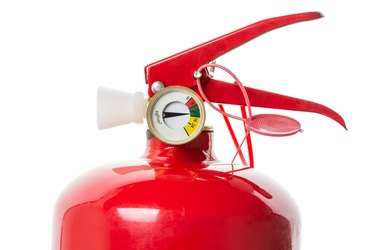
- Pressure. Does the extinguisher have suitable pressure? Some models have a gauge that you can check to ensure the pressure is within manufacturer's recommended range as displayed on the label.
- Damage. Has the fire extinguisher suffered any physical damage? Check the trigger for dents, the hose for kinks and the cylinder for rust. If you find any damage, play it safe and replace the fire extinguisher.
- Cleanliness. A fire extinguisher tends to collect greases and oils from the air, especially if you store it in the kitchen. These contaminants can make the extinguisher harder to handle. Clean them off periodically with soap and water.
When you need to use a fire extinguisher to put out a fire—especially an electrical fire—it's important check the label to make sure it's rated for the type of fire you need to put out. Using the wrong extinguisher can easily make the fire worse. If you have an extinguisher rated for Class A, B and C fires, you'll never have to worry about this.