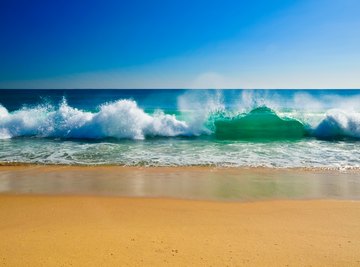

Breakers describe waves collapsing as they enter shallow waters in an ocean or lake. These furling waves may represent the climax of energy pulses that began hundreds or thousands of miles away out to sea. Beachgoers enjoy the surf that ocean breakers produce for its pleasant seaside soundtrack; surfers, of course, covet it for the wild rides it provides. But ocean breakers also play an important geomorphic role, funneling sand into coastal currents, depositing sediment, and – at their most violent – scouring away beaches, washing over islets and pummeling coastal ledges and cliffs.
How Waves Are Formed
A number of forces can set off the energy impulses that form waves at sea, including such dramatic ones as submarine earthquakes or ice calving off tidewater glaciers or ice shelves. But the most important by far is simply air movement. Wind sloughing over the ocean surface creates a frictional drag to produce ripples; stronger wind creates gravity waves.
Higher-velocity winds, or a longer runway over which winds can blow – a characteristic called fetch – produce larger waves due to a greater input of energy. Wave height also increases due to wind duration (how long the wind blows over a given swath of sea).
Although we think of ocean wave structures as humps of water traveling across long distances, they should more accurately be thought of as impulses of energy passing through the medium of water. The energy drives individual water particles in a circular, up-and-down motion as the impulse passes through – the top of this oscillation moving in the same direction as the wave – but they remain basically stationary.
Waves Becoming Swells
In an area subject to strong winds, as under an oceanic storm, chaotic waves create a distinct sea. But the waves produced in such generating areas can travel beyond them, and when they do they become the far-traveling versions known as swells. Swells represent more regular or smooth waves, often with longer periods (the length of time between successive wave crests or troughs) than the choppier, more confused wind waves within the generating area or sea. While waves do lose energy gradually once they leave their generating area, swells produced by major storms may journey all the way across an ocean basin.
Formation of Breakers
The oscillating movement of water produced by a traveling gravity wave – a movement that doesn’t much impact deeper water – is altered once the wave enters shallower depths. The friction of the seafloor causes the circular oscillation of the wave to become more elliptical or leaning, steepening the wave front. Eventually it steepens enough that the oscillation falls apart and the wave breaks. This typically happens when the depth of the water through which the wave is passing decreases to about one to 1.5 times the height of the wave.
On a gently rising seafloor, as along a very gradual beach face, the collapse of incoming waves often takes the form of spilling breakers, where the furling water basically runs down the moderate forward face of the wave. A steeper bottom tends to produce plunging breakers, which curl over upon themselves and crash down. Often the so-called breaker zone or surf zone in nearshore waters will include a line of spilling breakers farther offshore with plunging breakers inside, closer to the coastline.
Breakers may simply crash violently against a steep coastal formation such as a headland or sea stack, or they may sizzle their way up a gentler foreshore as swash. The water driven up a foreshore by breaking waves then slides seaward as backwash. Along many shorelines, that seaward movement takes the form of rip currents (or simply rips), which describe strong offshore flows of water through the breaker zone.
Significance of Breakers
Breakers are important forces when it comes to shaping the look of coastlines. Within the surf zone, their surge can stir up sand from the seafloor that longshore currents may then transport long-distance. Strong waves producing powerful breakers along so-called high-energy coasts erode beaches and other shoreline features, while the shallower, gentler breakers of low-energy coasts may be agents of deposition. Seasonality plays a role: Along the western seacoast of North America, storm-generated winter waves often eat away beaches, while milder summer waves build them back.
Huge, long-period swell waves can break with tremendous force of many tons, resulting in significant erosion of headlands and sea cliffs. Through a process called refraction, the bulk of incoming, erosive wave energy is often concentrated at obstructions such as headlands and capes, while intervening embayments are subjected to lower-energy waves that deposit sediment. In this way, over time, coastlines may tend to smoothen, as high-energy breakers gnaw away protruding landmasses and sediment builds up in the coves and bays between.
References
About the Author
Ethan Shaw is an independent naturalist and freelance outdoors/nature writer based in Oregon. He holds a B.S. in Wildlife Ecology and a graduate certificate in G.I.S. from the University of Wisconsin-Madison. His primary interests from both a fieldwork and writing perspective include landscape ecology, geomorphology, the classification of ecosystems, biogeography, wildlife/habitat relationships, and historical ecology. He’s written for a variety of outlets, including Earth Touch News, RootsRated, Backpacker, Terrain.org, and Atlas Obscura, and is presently working on a field guide.