How to Fashion a Boutonniere
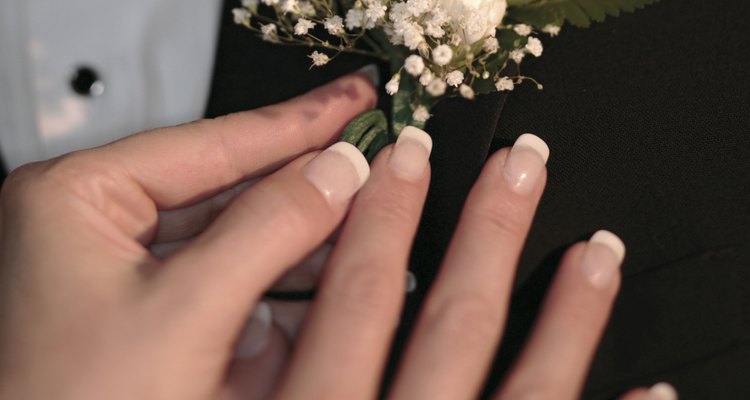
Whether resting in a lapel buttonhole or held in place by a corsage pin, the boutonniere is a time-honored addition to a man's special occasion attire. The mini-corsage lends a fresh, perfumed aroma and a gentle touch of nature to an elegant suit or tuxedo. Today's boutonniere designs can be as wild or sedate as the occasion and the wearer dictate. You can make a traditional rose and greenery boutonniere that measures 2 inches wide and 3 inches long and is finished with a small satin bow. Does this Spark an idea?
Things You'll Need
- Rose
- Fern sprigs, asparagus
- Leaf sprigs, small lemon
- Filler flower sprigs, baby's breath
- Ribbon, 1/2 yard, 1/4-inch-wide satin
- Green floral tape
- Floral stem wire, 12 inches, 16 gauge
- Boutonniere pin
- Needle-nose pliers
- Scissors
- Spray bottle and water
Instructions
-
-
1
Include fragrant greens in the arrangement. Choose the size, shape, color and materials of the project. A standard boutonniere is between 3 to 4 inches in finished length and 2 to 3 inches at its widest point, depending on the scale of the flowers, the greenery and the overall design concept. Most boutonnieres have a vertical shape and an upward line with the stem end pointing down. Choose colors that complement the occasion or the garment.
-
2
Select one or two well-formed fresh flowers for the focal point. Gently pull away and discard any damaged outer petals. Identify the front of the flower. Cut away the thorns and trim the stem to a generous 1 inch. Insert the floral wire horizontally through the stem and close to the base of the rose.
Draw the wire through to its center. Carefully bend the wire in half downward to create a wire stem. Beginning at the base of the flower, stretch and wrap the floral tape in a tight downward spiral to cover the wire. The tape sticks to itself when stretched.
-
-
3
Equip your work area with tools, supplies and a waste basket. Trim the bottom leaves of two citrus sprigs halfway up the stem. Position the sprigs on the backside of the rose in a pleasing manner. Apply floral tape to affix the leaves, spiraling down to the end of the leaf stem. Place, trim and affix the fern sprigs to the back in the same manner.
Choose a suitable section of the accent flower. After trimming the stem, place it in front of the rose. Stretch and apply floral tape slightly above the previous layers. Spiral the tape down to the end of the wire stem. Reverse the tape's direction and spiral up to the flower's base. Disconnect the tape and smooth the torn end down.
-
4
Wear the boutonniere on the left lapel inches above the heart. Grab the end of the covered wire stem with needle-nose pliers and wind the stem around the pliers several times. Continue until you have created a few spirals of graduated sizes. Release the pliers and manually adjust the loops.
Center ribbon on the backside of the project. Tie a knot and a bow at the center front. Trim away the ribbon ends to a pleasing length. Insert the boutonniere pin into the layered floral tape at the base of the flower.
-
1
Tips & Warnings
These mini-corsages can also be made of dried or silk flowers and greens, feathers, stem-mounted rhinestones or any other material that can be bunched together.
Lightly mist the rose and greenery with water and refrigerate the finished boutonniere to keep it fresh.
Carnations, gardenias and Gerber daisies are sturdy and work well for this project.
Choose maidenhair, lace fern, lily of the valley or limonium as accents.
Use greenery sparingly to keep the overall size to a minimum and keep the focus on the flower.
Handle the rose with care to avoid damage to the petals or the stem.
Keep craft tools and supplies away from small children and pets.
Resources
- Photo Credit Buccina Studios/Digital Vision/Getty Images George Doyle/Stockbyte/Getty Images Jupiterimages/Comstock/Getty Images Jupiterimages/liquidlibrary/Getty Images