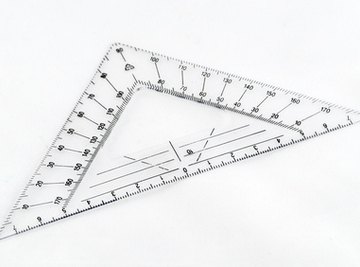

One of the most challenging tasks that some will face when it comes to dealing with math issues is the ability to calculate angles in a triangle. There are multiple ways to calculate angles, and it is all dependent on the information that is available for the triangle that you are working with. So get ready for some basic information to aid you in your quest to learn how to calculate angles in a triangle.
Calculate Angles
Calculating the angles in a triangle in which two of the angle measures are available is the first item that you will master. Here you will add the two angles that you have together and then you will subtract that total from 180. Since all triangles have a total sum of their angles equal to 180, the difference gives you the third angle.
Determining the measure of angles in an isosceles triangle is also a task that is accomplished with simple calculations; an isosceles triangle is a triangle in which two of the sides of the triangle are of equal length. In this type of triangle, two of the angles will have the same degree measure while the angle that forms from the two sides that are the same length will be the angle that has a different measure from the other two. If you have one of the angle measures in an isosceles triangle, you can determine the other two through simple subtraction from 180. If you have the measure of the angle that is different from the other two, you can subtract from 180 and then divide by 2 to get the measure of the other two angles, or if you have the measure of one of the two angles that are the same you multiply that by 2 and then subtract from 180 to determine the third angle.
Finding the measure of the angles of an equilateral triangle is the simplest of the calculations to do when it comes to triangles. This is because you simply need to divide 180 by 3 and get 60. When you have a triangle where all three sides are equal, the angles will all be equal as well.
About the Author
This article was written by the CareerTrend team, copy edited and fact checked through a multi-point auditing system, in efforts to ensure our readers only receive the best information. To submit your questions or ideas, or to simply learn more about CareerTrend, contact us [here](http://careertrend.com/about-us).
Photo Credits
triangle image by Zbigniew Nowak from Fotolia.com