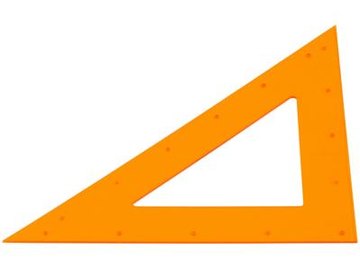

Sine, cosine and tangent, often shortened to sin, cos, and tan in mathematical operations and on calculator keys, are the most basic trigonometric functions. All three are based on the properties of a triangle with a 90-degree angle, also known as a right triangle. By knowing the sides of the triangle, referred to as the opposite side, which is farthest from the angle, the adjacent side, which is just next to the angle, and the hypotenuse, which is opposite the 90-degree angle, you can discover these three trigonometric functions.
Divide the measurement of the side opposite the angle with the measurement of the hypotenuse to find the sine of the angle. For an example, the measurement of the opposite side is 3 and the measurement of the hypotenuse is 5. Dividing 3 by 5 results in 0.6. The angle's sine is 0.6.
Divide the measurement of the side adjacent to the angle with the measurement of the hypotenuse to find the cosine of the angle. Continuing with this example, the measurement of the hypotenuse is the same and the measurement of the adjacent side is 4. Dividing 4 by 5 results in 0.8. The angle's cosine is 0.8.
Divide the measurement of the opposite side with the measurement of the adjacent side to find the tangent of the angle. Concluding this example, dividing the opposite side's measurement of 3 by the adjacent side's measurement of 4 results in 0.75. The angle's tangent is 0.75.
References
About the Author
Chance E. Gartneer began writing professionally in 2008 working in conjunction with FEMA. He has the unofficial record for the most undergraduate hours at the University of Texas at Austin. When not working on his children's book masterpiece, he writes educational pieces focusing on early mathematics and ESL topics.
Photo Credits
PhotoObjects.net/PhotoObjects.net/Getty Images