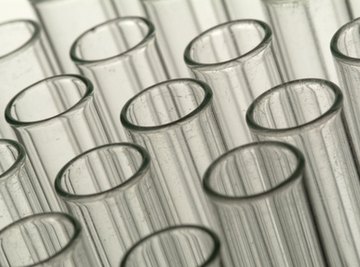
The separation of mixtures is a fundamental science experiment that is performed in many classrooms around the world to teach students the basics of procedures like filtration, heating, and evaporation. When attempting to separate a mixture of sand and salt, you'll need some standard lab equipment like glass containers, filter paper and a bunsen burner.
- Test tube
- Water
- Filter paper
- Filter funnel
- Crucible or evaporating basin
- Tripod
- Bunsen burner
- Heat lamp or sunlight
As a general rule, you should always wear protective eyewear when heating materials with a bunsen burner.
Fill a test tube about half-way with the sand-salt mixture.
Pour water into the test tube. Use enough water to completely submerge the sand-salt mixture.
Stir or shake the mixture for a few minutes so that the salt dissolves in the water. The sand is insoluble, so it will remain visible.
Curl a piece of filter paper into a cone shape and place it in a filter funnel.
Pour the mixture through the filter funnel into a crucible or evaporating basin. The filter paper will hold back the sand and only allow the salt solution to pass through it.
Place the crucible containing the salt solution on a tripod, and heat the bottom of it with a bunsen burner. After a while, the water will evaporate, leaving only the salt crystals behind.
Place the wet filter paper with the sand under a heat lamp or leave it in the sun to dry it out.
Scrape the salt crystals out of the crucible. You should now be left with a pile of sand and a pile of salt, having successfully separated the two from the mixture.
Things You'll Need
Warnings
References
About the Author
Along with SEO experience, Wes Walcott has been writing since 2009. He has written for various online publications including Kotaku and Gamespot. Walcott has his technical writing certification from Clemson University and a Bachelor of Commerce in marketing management from the University of Guelph.
Photo Credits
Verrerie de laboratoire. image by Photon BLEU from Fotolia.com