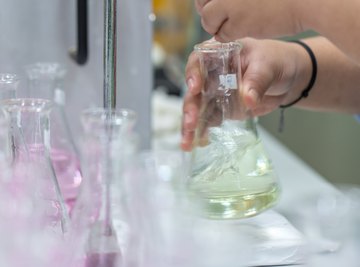

Chemists use an analytical technique called “complexometric titration” to analyze the amounts of dissolved metals in solutions. The technique typically involves placing the metal-containing solution in a beaker or flask and adding a complexing agent, such as ethylenediaminetetraacetic acid, or EDTA, dropwise from a buret. The complexing agent binds to the metals and, after all the metals have been complexed, the next drop of complexing agents binds to an indicator to induce a color change. The color change allows the chemist to know when the titration is complete. Eriochrome black T, or EBT, represents one of the color-changing compounds for such titrations. EBT, however, is a solid and must be prepared as a solution prior to its use as an indicator.
- Gloves and safety glasses
- 0.5 g solid Eriochrome Black T
- Balance capable of measuring to 0.1 grams
- Small beaker or flask
- 100 mL 95 percent ethyl alcohol (ethanol)
- 4.5 g hydroxylamine hydrochloride
- 100-mL graduated cylinder
- Glass dropper bottle
EBT indicator solutions typically exhibit very short shelf lives. Always prepare a fresh EBT solution when performing complexometric titrations.
Hydroxylamine hydrochloride is highly toxic and corrosive to skin and mucous membranes. Avoid direct skin contact. Wear rubber gloves and protective eyewear at all times when handling this compound.
Ethyl alcohol is flammable. Avoid working near open flames or other possible sources of ignition.
Put on gloves and protective eyewear and weigh out approximately 0.5 g of solid Eriochrome Black T, (EBT) on a balance and transfer it to a small beaker or flask. Add about 50 mL of 95 percent ethyl alcohol and swirl the mixture until the EBT has fully dissolved.
Weigh out 4.5 g of hydroxylamine hydrochloride on a balance and transfer it to the beaker or flask containing the EBT. Swirl until the hydroxylamine hydrochloride has fully dissolved.
Transfer the solution containing the EBT and hydroxylamine hydrochloride to a 100-mL graduated cylinder. Add enough 95 percent ethyl alcohol to bring the total volume to exactly 100 mL.
Transfer the EBT solution from the 100-mL graduated cylinder to a dropper bottle and label the bottle “0.5% Eriochrome Black T in Ethanol.”
Things You'll Need
Tips
Warnings
References
Tips
- EBT indicator solutions typically exhibit very short shelf lives. Always prepare a fresh EBT solution when performing complexometric titrations.
Warnings
- Hydroxylamine hydrochloride is highly toxic and corrosive to skin and mucous membranes. Avoid direct skin contact. Wear rubber gloves and protective eyewear at all times when handling this compound.
- Ethyl alcohol is flammable. Avoid working near open flames or other possible sources of ignition.