
Jack Hollingsworth/Photodisc/Getty Images
Kinship diagrams, or kinship charts, are used to organize information on familial lineages. A kinship diagram is a family tree that uses both symbols and letters to designate position and relation. Kinship diagrams can focus on the relatives of one person or the relationships of an entire family. To make a kinship chart, collect as much information about your family tree as possible.
Draw each female family member as a circle. Draw each male member as a triangle. If the gender is unknown, represent that person as a square.
Determine the central person, or Ego, of the diagram. Draw the Ego -- circle or triangle -- in the center of a piece of paper. Each relationship will stem from the Ego.
Draw the Ego's parents directly above the Ego. Parent-child relationships are represented with a vertical line. If the parents are married, connect their symbols with an equal sign. If they are divorced, draw a slash through the "=" sign. If the parents are not married, use a "~" sign.
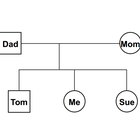
Draw the Ego's siblings, using a vertical line from the parents and a horizontal line from the Ego. If the sibling is biological, use a solid line. If the sibling is adopted, use a dotted line linking the adopted child to the parents and the other siblings.
Continue to expand your Kinship Diagram to include grandparents, uncles and other relatives. If a person is deceased, put an "X" through the triangle or circle.
Add referent symbols if your Kinship Diagram is too extensive or confusing. Referent symbols show relationship to the Ego, such as "M" for mother, "F" for father and "C" for cousin.
Related Articles
How to Draw Genograms

What Are the Genogram Symbols?

How to Make a Genogram Chart
Family Tree Rules

How to Draw a Family Tree When There Is ...

How to Do a Genogram
How to Make a Free Genogram

How to Make a Family Tree With Ex ...

What Is a First-Degree Relative?

How to Deal with an Oversensitive ...

The Effects of an Absent Mother Figure

Genograms & Ecomaps

How to Wear an Irish Wedding Ring

Importance of the Brother Sister Bond

Coping Skills for When Emotional ...

How to Make a Memory Book for a Gift

Factors Contributing to a Divorce

How to Read a Man's Body Language

How to Fix a Broken Sibling Relationship

How to Compose a Sympathy Message that ...
References
Resources
Writer Bio
Jessica Ring began writing and editing professionally in 2006 for "The Voice," her university's collegiate newspaper. She is a certified English teacher with a Bachelor of Arts in communication and English literature. She is currently in the process of obtaining her master's degree in education.
Photo Credits
Jack Hollingsworth/Photodisc/Getty Images