Baby duck identification is often challenging for beginners; when the ducks in question are downy hatchlings without telltale feather coloration, the task can be nearly impossible. In some cases, positive identification is only possible once the bird matures. Consider characteristics other than feather color that may indicate to which breed your pet duckling belongs.
Video of the Day
Look for body characteristics
If your ducklings are accompanied by a parent duck, it will be much easier to figure out their breed. However, buying a duckling at a feed store or other retailer might not always come with a description of the breed for sale. Know duckling characteristics to get an idea of what type of duckling you might be bringing home.
Video of the Day
Ducklings come in various combinations of just a few basic colors. Yellow ducks will grow up to be white or buff-colored ducks as adults. Brown and white duck breeds are often downy yellow with shadowy brownish sections that can resemble dust or dirt. Black and yellow ducks are likely mallards, wood ducks, Rouens, and black and brown "ducklings" usually grow up to be geese. Other ducks' down might be gray or brown.
To get a better idea of breed, look to a duck's body build, how it holds itself, its markings, and the color of its beak and feet. Most ducks are short and squatty, but meat breeds will be wide at the chest, and Indian Runners appear tall and skinny. Feet and beaks of various duck breeds might be yellow, orange, gray, bluish, black, or brown. Search online for types of ducks with pictures to get an idea of baby duck identification.
Yellow duckling breeds
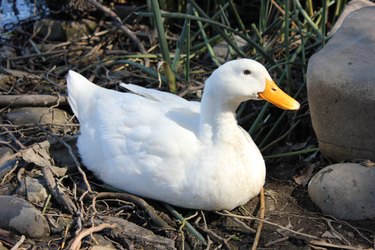
Pekin ducks are the most commonly kept duck breed. They provide 95 percent of the duck meat consumed in the United States and have a broad-breasted long body. Pekin ducks match the mental image most people have when they envision a hatchling; the young ducks are covered in yellow down and have orange beaks and feet.
Indian runners stand tall
Indian runner ducks are the easiest duckling breed to identify, no matter their color. Their posture differs from that of most other ducks in that they stand stretched up vertically as opposed to the more squatted posture of other breeds.
Although runner ducklings are often yellow, they occur in a wide variety of colors and patterns. Yellow ducklings might have patches of brown indicating that they'll be fawn or white. Some are blue-gray and chocolate. However, all Indian runners have their characteristic "standing tall" posture.
Unmasking Muscovy ducklings
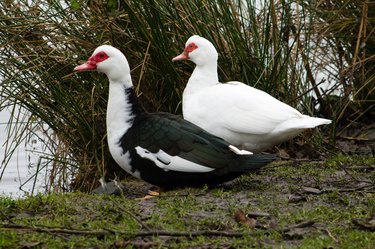
Muscovy ducks are the only domestic duck breed that does not descend from mallards (Anas platyrhynchos). Instead, they represent a different duck species, called Cairina moschata. Unfortunately, while mature Muscovy ducks are easy to distinguish from mallard-derived breeds by observing their abundant facial skin and bulkier build, the hatchlings are difficult to distinguish from wild mallards, Pekin ducks, or other breeds.
Further complicating matters, the breed exhibits a number of color mutations, which can produce ducklings clad in yellow down, brown down, or a combination of both. Additionally, depending on which color mutations, if any, are present in the animal, Muscovies may have brown, black, gray, pink, or orange beaks.
Unique muscovy characteristics include a hissing sound instead of quacking and pronounced toenails for roosting in trees. They don't have as much oil as other ducks and tend to not swim as much as other duck breeds.
Look for the lines
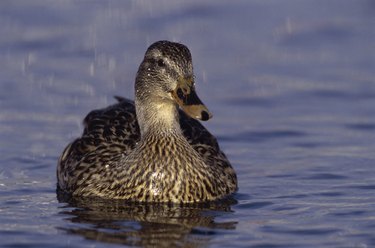
Although they are not a true breed in the strictest sense of the word, many people keep wild-type mallards, rather than their domestic descendants. Because they must avoid drawing the attention of predators, hatchling mallards are often clad in a combination of yellow and dark brown feathers, which help to break up their outline, thereby allowing them to blend in with their surroundings.
Wild-type mallards usually have a dark line that passes through their eye. Their beaks are usually rather dark, although yellow and red areas are occasionally present.