


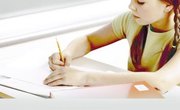
Some children learn and concentrate better when teachers incorporate physical activities into the learning process. These students are referred to as hands-on learners, doers or kinesthetic learners. To help these children succeed academically, you should combine ordinary school lessons, such as vocabulary or reading lessons, with kinesthetic activities. Kinesthetic activities involve getting the kids moving around or allowing them to work with their hands.
Grammar Activities
Many teachers use worksheets to teach their students basic grammar. Instead, turn your grammar lesson into a kinesthetic activity. After explaining the fundamental concepts of a sentence -- each sentence needs a noun and verb to be a complete sentence -- give half the class a slip of paper with a noun and the other half a paper with a verb. Have them walk around and find a classmate to make a complete sentence with. As your lessons progress into more complicated grammar, such as independent and dependent clauses, hand out papers with these parts of a sentence and have the kids combine to form a complete sentence. The students move around and learn at the same time.
Literature Skits
Literature provides a great opportunity to use kinesthetic activities, whether you’re teaching first-graders or high school students. Instead of having the kids quietly read to themselves or out loud from their desks, get them on their feet and have them act out the scenes as they read them aloud. This helps kinesthetic learners better understand literary elements such as plot and characterization, and keeps them focused and interested in the subject matter. Plus, it can be a fun activity.
Vocabulary Charades
Turn your vocabulary lesson into a game of charades. Assign each student a word on a slip of paper. One at a time, the students come up to the front of the classroom and try to act out that word as the other students guess the word. You can also break the classroom into groups to play this game. A vocabulary charades game also works for learning vocabulary words in Spanish, French or any other language class.
Model Building
To help kinesthetic learners grasp their science and social studies lessons, build models in class. Though sitting at their desks, models keep kids’ hands busy and moving. For science lessons, kids can build dinosaurs, skeletons or DNA models, depending on their grade levels. When learning about the Wright brothers in social studies, have the student build models of airplanes; build covered wagons when learning about the Oregon trail; make car models when studying Henry Ford.
Related Articles



References
Writer Bio
Kristen Marquette has been a professional writer since 2009 when FireLight Books published her debut novel, "The Vampiric Housewife." Since 2000 she has helped students hone their written and verbal skills in English as a tutor. She has a Bachelor of Arts degree from Michigan State University.