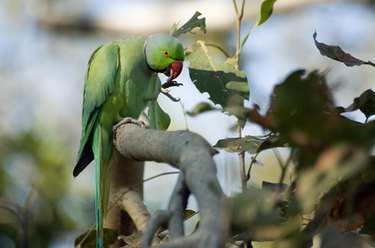
How to Breed African Eye-Ring Lovebirds

African eye-ring lovebirds are very energetic, curious birds. They often have very charming personalities, and they can be socialized to enjoy time with humans, although this requires serious daily commitment. Whether you wish to handle them or not, African eye-ring lovebirds are fascinating birds that breed relatively easily when kept correctly. They thrive when kept either individually or in a colony of birds, and colonies often chatter and chirp to each other, which is a beautiful sound.

Things You'll Need

  • Large cage
  • Thermometer
  • Lovebird pellets
  • Fresh fruit
  • Bird toys
  • Nesting box
Show More

Instructions

    • 1

      Check that your lovebirds have enough space. As lovebirds love to fly and move around, always provide the most space possible. Your lovebirds will be much happier in a roomy environment that lets them live more naturally. The minimum amount of space for one lovebird is 24 inches (60 cm) wide by 14 inches (35 cm) deep by 30 (76 cm) inches high. Two birds require double the space.

    • 2

      Record the temperature constantly for a few days. You can purchase electronic temperature trackers which will do this for you, or make a note of the temperature hourly. Lovebirds can thrive in a variety of temperatures, but drafts and sharp temperature changes can affect both their happiness and their health. If you notice the temperature is not consistent, consider moving the cage.

    • 3

      Feed your birds a varied diet. Lovebird pellets should make up around 70 percent of the birds' diet, as these are formulated to contain vitamins and nutrients vital to your birds' health. However, these should be supplemented with leafy greens, carrots and bananas. Lovebirds should not be fed chocolate, avocado, fruit seeds, caffeine or alcohol, as these substances can cause serious health problems.

    • 4

      Change your lovebirds water daily, using chlorine-free, filtered water. Try to do this at the same time each day. Birds that are dehydrated or that have limited access to fresh water will not breed.

    • 5

      Provide toys to keep the birds entertained. Bird toys suitable for lovebirds are available from most pet shops, and usually feature mirrors, bells or ropes. Lovebirds love to chew and find mirrors fascinating, so these toys will keep them stimulated and healthy.

    • 6

      Offer the birds a bath two or three times a week. Birdbaths are available from most pet shops, and if you place these in the cage the birds should bathe themselves.

    • 7

      Provide a nesting box. A cockatiel nesting box is perfect, as the bigger size gives the chicks more time to grow. Fill the bottom of the box with a 2-inch layer of a suitable nesting material such as clean straw, shredded newspaper or unscented white towels.

    • 8

      Give the birds time to breed. If you have checked all of the above, your birds will be in good condition and should be happy to breed. This can take some time, however, depending on the individual bird.

Tips & Warnings

  • Some people find that removing bird toys at night causes the birds to breed. If you are going to use this technique, ensure you replace the toys in the daytime, as bored birds will become unhappy.

  • Do not use wood shavings as nesting material. Wood shavings can contain hydrocarbons, which can cause harm to your birds.

Related Searches:

References

Comments

You May Also Like

  • The Difference Between Male & Female Lovebirds

    Identifying male and female lovebirds is challenging. For those with lovebirds as pets, this is not so much of a problem. However,...

  • How to Breed Lovebirds

    Breeding lovebirds isn't easy, but it's very rewarding if you have the time and energy. These sweet little parrots make good parents,...

  • African Lovebird Foods

    African Lovebird Foods. The African lovebird is a type of parrot that originates from Africa and Madagascar. There are nine different species...

  • How to Determine the Gender, Lifespan and Weight of a Lovebird

    A pet lovebird can bring you a lot of enjoyment. Many lovebird owners leave the pet store with many questions about their...

  • Kinds of African Lovebirds

    Kinds of African Lovebirds. Lovebirds live in Africa and Madagascar. In the wild, they live in flocks of varying size depending on...

  • Aviary Styles for African Lovebirds

    Of the nine species of African lovebirds, eight can be kept as pets. Also called "pocket parrots," lovebirds are known for the...

  • How to Handle a Lovebird

    Comments. You May Also Like. How to care for a single lovebird. When one of a pair of lovebirds dies, it is...

  • Grooming Your Lovebird

    Bathing your pet lovebird safely with a spray bottle is discussed in this free video .

  • How to Breed African Love Birds

    African lovebirds are small parrots that can be friendly, personable pets. There are nine distinct species of African lovebirds, but they can...

  • African Bird Identification

    In addition to being the world's second largest continent, Africa is also home to the Sahara, the world's largest desert, and the...

  • Different Kinds of Love Birds

    Different Kinds of Love Birds. Lovebirds are small parrots originating in Africa and Madagascar. Scientifically their genus is known as Agapornis, and...

  • How to Identify Lovebird Breeds

    There are nine subspecies of lovebird, each with their own identifying characteristics. Follow these steps to differentiate among them.

  • Types of African Jewelry

    Africa is a large and diverse continent. Split into many different countries, each with its own people and tribal traditions, Africa has...

  • How to Domesticate Lovebirds

    Lovebirds originate from Africa and are distinguished by their bright yellow, red, pink, green and orange feathers. Lovebirds are one of the...

  • How to Propagate Love Birds

    Lovebirds, which are small, beautiful parrots, can live for 10 years or more. They have no talking ability but are voracious chewers....

  • Feather Plucking Causes in Lovebirds

    Feather plucking is destructive behavior in which all or part of the feathers are pulled out. Feather plucking in lovebirds can occur...

  • How to Breed Love Birds

    Lovebirds can make wonderful companions and it's easy to see why so many people keep them as pets. At some point you...

  • How to Breed African Greys

    Breeding African Greys may seem like fun, but it is really something that you cannot just jump into. Not only is it...

  • Wooden Homemade Bird Cages

    A wooden bird cage can be made at home with only a few hours work. The size of your cage will be...

  • Home Treatment for Dark Circles Under the Eyes for African American Women

    Looking into someone's eyes could reveal something about that person's lifestyle. Dark under-eye circles are not attractive, and could be caused by...

Related Ads

Featured