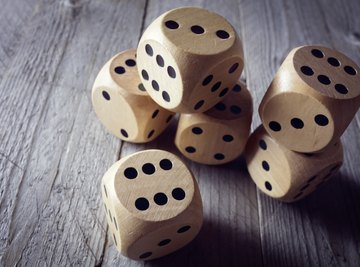

The probability of an event is the chance that the event will occur in a given situation. The probability of getting "tails" on a single toss of a coin, for example, is 50 percent, although in statistics such a probability value would normally be written in decimal format as 0.50. The individual probability values of multiple events can be combined to determine the probability of a specific sequence of events occurring. To do so, however, you must know if the events are independent or not.
First, watch the video below for a quick refresher on basic probability:
- Determine the individual probability (P) of each event that is to be combined. Calculate the ratio m/M where m is the number of outcomes that result in the event of interest and M is all possible outcomes. For example, the probability of rolling a six on a single die roll can be calculated using m = 1 (since only one face gives a result of six) and M = 6 (since there are six possible faces that could turn up) for P = 1/6 or 0.167.
- Determine if the two individual events are independent or not. Independent events are not influenced by each other. The probability of heads on a coin toss, for instance, is not affected by the results of a prior toss of the same coin and so is independent.
- Determine if the events are independent. If not, adjust the probability of the second event to reflect the conditions specified for the first event. For example, if there are three buttons -- one green, one yellow, one red -- you may wish to find the probability of picking the red and then the green button. P for picking the first button red is 1/3 but P for picking the second button green is 1/2 since one button is now gone.
- Multiply the individual probabilities of the two events together to obtain the combined probability. In the button example, the combined probability of picking the red button first and the green button second is P = (1/3)(1/2) = 1/6 or 0.167.
Tip: This same approach can be used to find the probability of more than two events.
References
About the Author
Michael Judge has been writing for over a decade and has been published in "The Globe and Mail" (Canada's national newspaper) and the U.K. magazine "New Scientist." He holds a Master of Science from the University of Waterloo. Michael has worked for an aerospace firm where he was in charge of rocket propellant formulation and is now a college instructor.