Through the process of evolution, a species acquires adaptations that make it uniquely suited for survival in its environment. An adaptation is a physical trait or behavior encoded in genetic material and inherited from previous generations. The black widow spider, one of the world's most dangerous insects, adapted to its North American environment for millions of years.
General Description
Black widow spiders are primarily native to areas of the United States, although they live throughout the Americas. These spiders often live close to the ground in dark places. The poisonous female black widow is larger and has a distinctive black body, with a red hourglass on the abdomen. Male black widows are smaller, with brown- and orange-striped legs, and are not poisonous.
Venom and Feeding
The black widow spider is famous for its dangerous bite, with venom 15 times stronger than a rattlesnake's. However, the black widow did not evolve a bite as a defense against larger creatures. Instead, the neurotoxic venom is an adaptation that allows the spider to paralyze its prey. After catching an insect in its web, the black widow bites to incapacitate the bug. Once the prey is still, the black widow injects enzymes to begin digestion outside the spider's body. Black widows are exclusively carnivorous and feed on a variety of insects as well as other spiders.
Webs
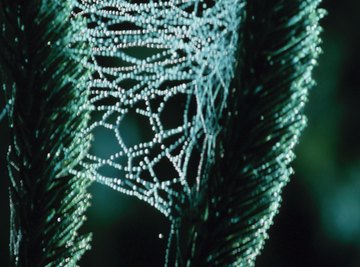
Black widows produce large quantities of sticky, irregular web. For feeding, a black widow spins a funnel-shaped web and waits at the center, hanging upside down to sense vibrations. This feeding web is a complex adaptation for the purpose of trapping prey. Sticky "trap threads" designed to immobilize prey supplement the thicker structural lines of the web. The funnel shape allows the spider to perch in the center and easily feel vibrations from any line of the web.
Reproduction
The black widow is a solitary creature with intricate mating rituals. The male spider spins a "sperm web" before setting off to find a female spider. He communicates with the female by vibrating the strands of her web. If he is successful, she allows him to approach and mate. After copulation the female may eat her partner, but he may also escape unscathed. Later, the female will lay fertilized eggs and spin them into an egg sac, which she carries with her and protects.
References
About the Author
Mary MacIntosh has been writing professionally since 2007, contributing articles to "The California Tech" and serving as an editor for the "Biweekly Frink Digest." She is pursuing a Bachelor of Science in computational neuroscience at the California Institute of Technology.
Photo Credits
Hemera Technologies/AbleStock.com/Getty Images