How to Use Dental Tools at Home to Remove Plaque
Tartar, or calculus, refers to the rock-hard mineral formations around the edges and bottom of teeth. They are not just unsightly. They're the leading cause of gingivitis and gum disease, which leads to tooth loss. Plaque is the sticky white film that forms around your teeth, made up mostly of saliva and bacteria. When left alone, it develops into calculus within 12 days. Removal of plaque from the surfaces of your teeth prevents tartar buildup and is the most important step in maintaining good oral hygiene.
Removing Plaque at Home
Hold your toothbrush at a 45-degree angle and brush gently along the upper and lower front teeth, cleaning all the way to the back teeth. Lay the toothbrush flat and brush the occlusal surface (chewing surface) of the upper and lower teeth. Tilt the brush to a vertical position and clean the inner surface of the top and bottom anterior teeth. Rinse with water three times.
How to Remove Tooth Tartar at Home
Learn More
Wind 18 inches of floss around your middle fingers and gently floss between teeth. The floss should guide along the tooth surfaces, all the way down to the root at the gumline, and back up to the tip of the tooth. Use a new section for each tooth area. This is the most important step in plaque removal.
Take the dental scaler and lay the flat edge against the surface of teeth. Start at the gumline and pull away to the top of the teeth. Cover all surfaces.
How to Clean Germs Below the Gumline
Learn More
Use the dental pick to target the area between teeth, removing any hardened food particles. Place the pick near the gumline between the teeth and drag upward to the top of the teeth.
Occasionally, use baking soda and salt on your toothbrush. Wet slightly, and brush your teeth from front to back at a 45-degree angle. Baking soda is a natural buffer that freshens breath but excels at removing plaque. Salt acts as a natural alkaline buffer to combat the acidity of plaque.
Rinse your mouth out with water after every meal, if you do not have access to a toothbrush or mouthwash. Chewing sugarless gum may also prevent plaque buildup.
Invest in an electric toothbrush like Oral-B 3D 1. A study reported in the American Journal of Dentistry found that the Braun Oral B removed 30 percent more plaque than the Sonicare 1. Another study showed that it kept 53 percent of tooth surfaces plaque-free compared to manual toothbrushes, which left 32 percent of tooth surfaces plaque-free.
Tips
Use a soft-bristled toothbrush to prevent enamel and gum damage. Toothpaste, while excellent in preventing cavities, is not a necessity for plaque removal.
Warnings
Toothbrushing should last two to four minutes, or it can be ineffective in total plaque removal.
- Hold your toothbrush at a 45-degree angle and brush gently along the upper and lower front teeth, cleaning all the way to the back teeth.
- Use the dental pick to target the area between teeth, removing any hardened food particles.
Related Articles

How to Remove Tooth Tartar at Home
Learn More
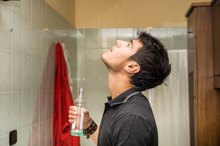
How to Clean Germs Below the Gumline
Learn More

How to Use a Dental Scaler
Learn More

Does a Waterpik Remove Tartar?
Learn More
The Best Ways to Water Clean Teeth
Learn More
How to Use Peroxide in My Waterpik
Learn More
How to Remove Gum Line Stains
Learn More
How to Make Your Own Tooth Caps
Learn More
How to Clean a Toothbrush
Learn More
How to Use a Waterpik for Receding Gums
Learn More
References
- Oral-B Study
- The American Dental Association. Eruption Charts. Oral Health Topics.
- The American Dental Association. Oral Health Topics. Eruption Charts.
Tips
- Use a soft-bristled toothbrush to prevent enamel and gum damage. Toothpaste, while excellent in preventing cavities, is not a necessity for plaque removal.
Warnings
- Toothbrushing should last two to four minutes, or it can be ineffective in total plaque removal.