English and Western saddles are two common types of horseback riding saddles. They look dramatically different; each is specially suited for the type of riding it was designed for. Which type of saddle best suits you depends on what riding discipline you pursue.
Types of Riding
Western saddles were designed for cowboys, who would spend long days in the saddle doing ranch work. Today, Western saddles serve other disciplines, including barrel racing, reining and cutting. English saddles are designed for jumping and dressage. The smaller saddles give riders more flexibility to move when jumping and closer contact with their horses for precision dressage movements.
Western Saddle Design
A Western saddle is larger and heavier than an English saddle, designed to distribute the weight of the rider over a greater surface, providing greater comfort for the horse during long rides. The large cantle at the back of the saddle, and the long fenders and stirrups provide a high level of comfort and security for the rider. The distinguishing feature of a Western saddle is the horn at the front of the saddle. The horn is where cowboys would wrap their rope when catching cattle or dragging objects.
Types of Western Saddles
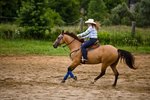
Western saddles can be tailored to the type of activity they will be used for. For example, a barrel racing saddle has a deep seat with a high cantle and horn to help the rider maintain her seat during sharp, fast turns. A reining saddle has a lower horn to allow for easier, more subtle movement of the reins. Close contact skirts give the rider more leg and seat contact with the horse.
English Saddle Design
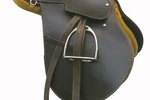
The English saddle is much smaller than the Western saddle; it is made with thinner, lighter leather. This gives the rider greater flexibility to move in the saddle and closer contact with the horse. The English saddle gives the horse more room and flexibility to move in the shoulder than a Western saddle. Thin stirrup leathers and smaller stirrups provide even greater flexibility of movement for jumping and for giving precise commands during dressage. Knee rolls provide padding where the knees rest to help hold the rider's legs in the correct position.
Types of English Saddles
A dressage saddle has a deep seat and long flaps. This supports the dressage rider's upright position and allows for the rider's legs to have close contact with the horse. Flaps on a jumping saddle are in a more forward position, allowing for the shorter stirrup length. In addition, the seat is shallower in a jumping saddle, allowing the rider to rise out of the saddle and achieve proper position over jumps.
References
Photo Credits
-
BananaStock/BananaStock/Getty Images
Writer Bio
Maureen Malone started writing in 2008. She writes articles for business promotion and informational articles on various websites. Malone has a Bachelor of Science in technical management with an emphasis in biology from DeVry University.