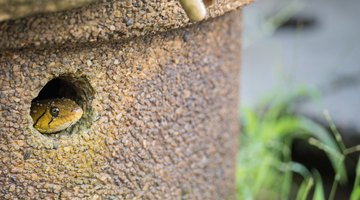
How to Identify the Snakes of Georgia

How to Identify the Snakes of Georgia thumbnail
A close look with tell you what kind of snake you see.

Snakes in Georgia can be identified by two types, poisonous and non-poisonous. Of the 41 species of snakes found in Georgia, only six are poisonous. Snakes' natural habitats are being destroyed, making it more likely that the general public will encounter a slithery friend (or foe). While any snake will bite if provoked, it is vitally important to be able to separate the potentially deadly venomous snakes from the non-venomous. Identifying a snake in Georgia is a matter of making some careful observations about the physical appearance of the snake. Make these observations from a safe distance. Does this Spark an idea?

Instructions

    • 1
      Look for the accentuated neck of a poisonous snake.
      Look for the accentuated neck of a poisonous snake.

      Look at the shape of the snake's head. All but one of the venomous snakes in Georgia has a triangular shaped head. The base of the head is much broader than the tip. It almost looks like it has a neck. Non-poisonous, or non-venomous, snakes will have a rounded head without the obvious broad base. Their body will be virtually straight from tip to tail unless they are feeling threatened, then they will flatten their head.

    • 2
      Round eyes indicate a non-poisonous snake.
      Round eyes indicate a non-poisonous snake.

      Look at the snake's eyes. Non-venomous snakes have round, circular pupils. The venomous, or poisonous, snake will have elliptical pupils that look like a cat's eyes. Their eyes are oval, not round.

    • 3
      The pit on a poisonous snake is used to the detect body heat of potential prey.
      The pit on a poisonous snake is used to the detect body heat of potential prey.

      Look for a small pit between the snake's nose and eyes. All poisonous snakes in Georgia will have a heat-sensing pit on each side of the head. This pit is the origin of the term "pit-viper" sometimes used to describe a venomous snake. Non-poisonous snakes do not have these pits. The area between the nostril and eye will be smooth.

    • 4
      Poisonous snakes look fat and thick in the middle.
      Poisonous snakes look fat and thick in the middle.

      Observe the shape of the snake's body. Most non-poisonous snakes will have slender bodies. The poisonous snake's body is wide and thick. Do not confuse length with thickness. Snakes of either variety can range from a few inches to several feet in length.

    • 5
      Leaning skin pattern is an easy method for identifying poisonous snakes.
      Leaning skin pattern is an easy method for identifying poisonous snakes.

      Look for a skin pattern. The characteristics listed in the steps above are distinctive for the two types of snakes, but skin pattern is not. While most non-venomous snakes have only a minimal pattern, there are some that have variations in colors and stripes. The venomous snakes, on the other hand, will each have its own distinctive pattern of stripes or color splotches. Learn the skin pattern of each poisonous snake if you frequent areas that may be home to snakes (see Resources).

Tips & Warnings

  • Snakes only bite for two reasons: fear and food.

  • Wear protective boots and clothing if you are in snake habitats.

  • Never try to pick up or handle any snake. Although they do not have fangs and venom, even non-venomous snakes will bite.

  • Every wild species of non-venomous snakes in Georgia is protected. It is illegal to keep one of these as a pet without proper permits.

Related Searches:

References

Resources

  • Photo Credit BananaStock/BananaStock/Getty Images Jupiterimages/Photos.com/Getty Images

Comments

You May Also Like

  • How to Identify Common Snakes

    Where you live or how you spend your leisure time will determine how often you will see snakes. If you enjoy going...

  • Brown Snakes of Georgia

    According to Southern Reptile Education, 42 species of snake are native to the state of Georgia. Five of these species are venomous,...

  • How to Identify Snakes

    Snakes hold a mixture of fascination and repulsion for many people. Being able to identify them is a skill that would be...

  • Nonpoisonous Snakes in Georgia

    Most snake species are nonvenomous, meaning they do not have venom in their teeth or fangs. The venom of snakes is used...

  • How to Identify Garden Snakes

    Garden snakes are a commonly-used term associated with the agile, harmless snakes often discovered in a backyard garden. This snake species is...

  • How to Identify a Silver Snake

    Snake identification is extremely important due to the fact that many snakes are highly venomous and even deadly to humans. Certain snakes...

  • How to Identify a Baby Snake

    The intricate patterns on many snakes make it difficult to tell them apart. Most don't reach maturity until 2 to 4 years...

  • Identifying Snakes

    Whether you have a passion for snakes or an aversion for them, being able to identify snakes is important if you enjoy...

  • How to Tell if a Snake is Venomous

    So you pull the car into the garage and a slithery yellow-tan snake is sitting on the concrete step into the house....

  • The Types of Snakes Found in East Tennessee

    Knoxville lies at the heart of eastern Tennessee, a largely urbanized area that also includes the Great Smoky Mountains National Park. This...

  • Identifying North Carolina Poisonous Snakes

    Residents of and visitors to North Carolina need to know which snakes are poisonous and which are not. There are 37 different...

  • Snakes in Northern Georgia

    Snakes in Northern Georgia. North Georgia is characterized by eastern deciduous forests and the Appalachian Mountains landscape. From dry ridge-tops to wet,...

  • Snakes of Colorado

    Colorado has large areas of varied natural habitat which is suitable for an array of snake species. The state is home to...

  • How to Buy a Rough Green Snake

    A very common reptile, the rough green snake is a popular pet for people with exotic tastes. It is a very calm...

  • How to Identify Snakes in South Africa

    There are over 2,500 snake species in the world, with over 120 of them from South Africa. It is important to be...

  • How to Identify a Coral Snake

    For some time now, people will tell you that the way to identify a Coral snake is to remember the poem, "red...

  • Georgia's Snakes

    Georgia's snake population includes both venomous and nonvenomous snakes. The climate and landscape of Georgia provide the perfect habitat for around 40...

  • Common Snakes in Georgia

    The Appalachian Mountains and the eastern deciduous forests characterize the geography of Georgia. The Peach State has wet, marshy valleys and dry...

Related Ads

Featured