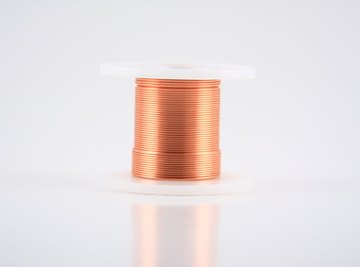

An inductor is basically just a coil of wire. The inductance of an inductor is a measure of its ability to store energy in the form of a magnetic field; when the current in the coil changes, it follows from Lenz's Law that the magnetic field will induce motion of charges in such a way that it will resist change in the current. The inductance is equal to the electromotive force or EMF per unit of rate of change of current. Inductance is measured using a unit called the Henry or H.
- Pencil
- Paper
- Calculator
- Ruler
- Coil of wire
The Henry is a very large unit. Most coils have inductances measured in milliHenries or mH.
If you find an answer that's much larger (or much smaller) than you expected, double-check your calculations. The most common error is to use the wrong units. Make sure you convert your length to meters and your cross-sectional area to square meters before you calculate inductance.
Measure the length of the coil of wire in meters or centimeters. It's important to use metric units, since the Henry is based on the metric system.
Determine how many turns there are in the coil -- i.e. how many times the wire is coiled.
Calculate the cross-sectional area of the wire coil by measuring its radius and plugging this into the formula π*r squared.
Calculate the inductance using the following formula: Inductance = µ (N squared) A / length, where N is the number of turns in the coil, A is the cross-sectional area of the coil, and length is the length of the coil. µ (or "mu") is a constant called the vacuum permeability constant and has the value 4π x 10 to the -7 H/m.
Things You'll Need
Tips
Warnings
References
- Georgia State University HyperPhysics: Inductance of a Coil of Wire
- Florida State University: Inductance
- "Physics for Scientists and Engineers"; Richard Wolfson and Jay Pasachoff; 1999.
Tips
- The Henry is a very large unit. Most coils have inductances measured in milliHenries or mH.
Warnings
- If you find an answer that's much larger (or much smaller) than you expected, double-check your calculations. The most common error is to use the wrong units. Make sure you convert your length to meters and your cross-sectional area to square meters before you calculate inductance.
About the Author
Based in San Diego, John Brennan has been writing about science and the environment since 2006. His articles have appeared in "Plenty," "San Diego Reader," "Santa Barbara Independent" and "East Bay Monthly." Brennan holds a Bachelor of Science in biology from the University of California, San Diego.
Photo Credits
spindle of copper wire on white background image by phizics from Fotolia.com