Things You'll Need
Speed Square
Level
Pencil
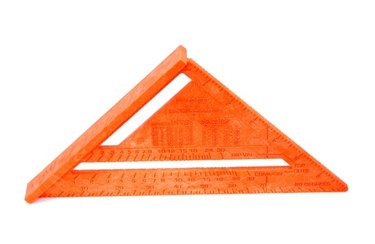
The Swanson Speed Square is a popular tool with most carpenters. The triangle-shaped "square" was invented in 1925 by Albert Swanson to provide a quick, accurate method for marking rafters. Because of its compact size, it is frequently used as a saw guide when cutting framing members as well as a layout tool for quick 45- and 90-degree cuts. Using this tool to determine the pitch of an existing roof is simple once you find the correct scale markings.
Step 1
Use a level and a pencil to make a plumb, vertical line on one face of an existing rafter.
Video of the Day
Step 2
Place the pivot point on the square against the bottom of the rafter and align the 90-degree angle side of the square with the pencil mark.
Step 3
Note the number on the "Common" scale parallel with the 45-degree angle of the square. The hash marks with corresponding numbers between 1 and 30 refer to the roof's rise angle. The pitch of the roof is read where the bottom of the rafter crosses this scale.
Tip
Roof pitch is commonly referred to in terms of the amount of vertical rise per foot of horizontal length. A roof with a 6:12 pitch rises 6 inches for every foot between the eave and the peak.
Video of the Day