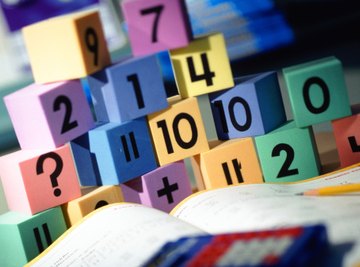

Learning fractions can be a dreaded experience for many elementary age students. Fortunately, fraction manipulatives aid in the learning process by setting a strong foundation from which to build upon. Manipulatives are any item that can be physically manipulated by a student with their hands to help them understand and work out problems. Fraction manipulatives are excellent learning tools and can be broken down into four categories.
Fraction Pies
Pie manipulatives can be a great way to model fraction equivalency. One pie is divided into any number of different size pieces and labeled with a fraction corresponding to its size. For example, one fraction pie may be made up of four unequal pieces including 1/2, 1/4, and two 1/8 pieces. Students can manipulate these pieces by placing the 1/4 piece over the two 1/8 pieces and determine that they are equivalent because they are the same size.
Fraction Sticks
Fraction sticks are used to add simple fractions. Each stick is labeled as an individual fraction depending on its length. The larger the fraction, the longer the fraction stick and students can manipulate the sticks by placing them above or below each other to determine if they are an equal or unequal length. For example, a student may place two 1/8 sticks under a 1/4 stick and see that two 1/8 sticks are the same length as one 1/4 stick. They now know that 1/8 + 1/8 = 1/4.
Fraction Cubes
Fraction cubes are usually made of foam and have a variation of fractions on each of the six sides of the cube. Students use the cubes like dice to play games so they can practice adding, subtracting, multiplying, and dividing fractions. For example, if the lesson being taught is focused on multiplying fractions, the teacher will divide the students into groups of two to four to work with the cubes. Each player rolls the fraction cubes and they have to multiply the two fractions that they roll.
Virtual Manipulatives
Virtual manipulatives are a newer trend in teaching fractions. Students work on a computer to manipulate fraction pies, sticks and cubes in a variety of engaging computer simulations. Virtual manipulatives are highly advantageous because they don't require any materials other than a computer and the variation of activities they can be used for is far more abundant than traditional manipulatives. Many math curriculums are purchased with disks that include virtual manipulatives or links to online virtual manipulatives.
References
About the Author
Stephen Hart has been writing for eHow since 2011. He received his Bachelor of Arts in elementary education from Washington State University in 2009 and is currently pursuing his special education certification.
Photo Credits
John Foxx/Stockbyte/Getty Images