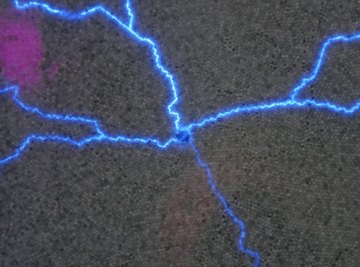

Electrostatic force is the force two electric charges exert on each other. It operates according to Coulombs law, which states that the electrostatic force between two charges is equal to the multiplication of the magnitude of the charges divided by the square of the distance between them. People experience this force every day through common electrostatic or "static" discharges. These discharges are generally weak and equate to a minor nuance. However, electrostatic discharges such as lightning can be quite powerful and deadly.
Find the magnitude of the first charge, or "q1," by referring to electrostatic lab results or research data backing your project. The unit of measure is coulombs.
Find the magnitude of the second charge, or "q2," the same way you found q1.
Find the distance, or "D," between the two charges at the time when the magnitudes were measured. Refer to electrostatic lab results or research data backing your project. Distance will be expressed in meters.
Calculate the electrostatic force using the formula: F = K[q1 x q2]/D^2 where K is coulombs constant, which is equal to 9 x 10^9 Nm^2/C^2. The unit for K is newtons square meters per square coulombs. As an example, if q1 is 6 x 10^-6 coulombs, q2 is 9 x 10^-6 coulombs and D is 2 meters:
F = K[q1 x q2]/D^2 = (9 x 10^9)[(6 x 10^-6)(9x 10^-6)]/(2 x 2) = (9 x 10^9)[54 x 10^-12]/4 = (486 x 10^-3)/4 = 121.5 x 10^-3 or 1.215 x 10^-5 newtons. Note: 1.215 x 10^-5 is scientific notation for 0.00001215.
About the Author
Dwight Chestnut has been a freelance business researcher and article writer for over 18 years. He has published several business articles online and written several business ebooks. Chestnut holds a bachelor's degree in electrical engineering from the University of Mississippi (1980) and a Master of Business Administration from University of Phoenix (2004).
Photo Credits
Jupiterimages/Photos.com/Getty Images