
Tanks and Regulators
Controlling a mechanism using pneumatics begins with pressurized gas. The gases most commonly used for this control are carbon dioxide, nitrogen, and high-pressured air. This gas is housed in a tank, which is usually compressed to thousands of pounds per square inch (PSI.)
Pneumatic controls also depend on regulators, which are attached to the gas tank. A regulator reduces the high pressure from the tank and lowers it to a more manageable pressure. Regulators work "on demand," meaning that instead of a constant stream, they release gas from the tank only when there is a drop in pressure in another part of the system.
Hoses and Valves
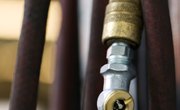
Pneumatic controls cannot function without hoses and valves delivering pressurized gas from the regulator to the rest of the system. These parts must be able to function under high pressure without rupturing. Hoses are often reinforced with steel to keep them strong as pressure moves through the lines.
Valves connect to the hoses and act as switches, stopping and starting the flow of pressurized gas as needed. When the user activates a valve, it opens very quickly and allows gas to move through. Closing the valve interrupts the flow and holds back the pressure. Valves can be activated manually, or remotely using motors and electronics.
Actuators
All other pieces, from the tank to the valves, are useless without an actuator. The actuator is the part that directly pushes or pulls objects when the pneumatic controls are activated.
Actuators consist of a cylinder with a disk and a rod housed inside. When a valve opens and high-pressure gas is allowed to enter the actuator, it forces the disk to move. This pushes the rod, which can be connected to any object that needs to be moved. For example, the rod may connect to a door needing to be opened, or a box to be lifted. The actuator is the final piece of the control system
Different types of actuators can be used, depending on the necessary task. Single-acting actuators move in only one direction when pressurized, and rely on gravity to return them to the start position. Double-acting actuators have pressure connections on both ends, allowing them to be forced in both directions.
References
About the Author
Benjamin Aries has been involved in digital media for much of his life and began writing professionally in 2009. He has lived in several different states and countries, and currently writes while exploring different parts of the world. Aries specializes in technical subjects. He attended Florida State University.
Photo Credits
Jupiterimages/PhotoObjects.net/Getty Images