

Correct Way to Use Concrete Blocks

Concrete blocks are used for various construction projects, such as retaining walls, building walls, foundation walls and basement walls. Regardless of what type of project you are undertaking, there is a universal standard for using concrete blocks. This is in place so that the blocks won't fail after they have been installed, which could be catastrophic. The good news is that concrete blocks can be installed by the average do-it-yourself homeowner successfully by following the aforementioned standards.
Footing
Concrete blocks must be installed on a solid footing. Depending on the height of the concrete block project, you will need to make sure that the footing is at least 16 inches wide and eight to 12 inches thick. The taller the block wall, the thicker the footing needs to be. A good footer will keep the concrete blocks from tumbling over after they have been installed onto it. The footer will also keep the blocks from settling and cracking. Never attempt to install a block wall over the top of dirt or crushed gravel. These types of footings will not suffice for holding up any type of block wall.
Using Concrete Blocks
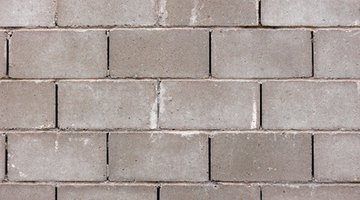
When installing concrete blocks, always use type S mortar for projects that will be supporting large amounts of weight, such as house walls, basement walls, foundations or retainer walls. The type S mortar will withstand greater forces without failing. Concrete blocks can be installed in two types of patterns: running bond or stacked bond. Running bond requires that the blocks be staggered over the top of each other. For example, if you are laying one long wall, the first row of blocks will be laid, then the blocks on top of that row will all be staggered over the previous blocks -- the end of the top block will stop in the middle of the previous block. This type of bond will afford the greatest strength for your concrete block project.
Stacked bond blocks do not stagger but are stacked, one on top of the other. This type of bond is for filling only and should never be used for a concrete block project that requires a strong block wall. The blocks should always be evened with a four-foot level to make sure that they are straight and level. Using a mason’s trowel to spread the block mortar onto the blocks is the best method for applying block mortar. After laying concrete blocks, you should allow them to dry for 24 hours before placing any pressure on them.
References
- Modern Masonry: Brick, Block, Stone; Clois E. Kicklighter; 1996
Resources
Writer Bio
Billy McCarley has been freelancing online since April 2009. He has published poetry for Dead Mule, an online literary publication, and holds a Bachelor of Arts degree from the University Of Alabama where he is also a first-year graduate student in history.
Photo Credits
- Structure from blocks image by amlet from Fotolia.com
- Structure from blocks image by amlet from Fotolia.com
More Articles

