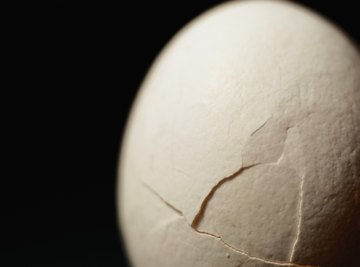

Science experiments can be done at home with common household items as easily as they are done in school; the science concepts are the same, and kids are astounded by simple hands-on activities that nearly any parent or teacher can accomplish. Create your next science experiment for the kids with a raw egg and vinegar. The egg shell will slowly dissolve leaving behind a bouncy egg.
Materials
The materials needed for this kids' science experiment is an uncooked egg in its shell, a cleaned out jam jar or other jam of similar size, and white distilled vinegar which is also known as as acetic acid; that will be the main chemical used for the experiment. A saucepan is an optional equipment for this activity if you decide to hard boil the egg.
Preparations
Place your raw egg into a saucepan with water if you want to hard boil the egg before the experiment. It is not necessary, but if your egg accidentally breaks it will be less messy if it is not hard boiled. To hard boil an egg, give it a gentle boil for about ten minutes and let the egg cool. Then pour 1 cup of white vinegar into the jar. Add the cooled egg to the jar for this experiment and be sure the egg is completely covered with the vinegar.
Observations
Observe the experiment for one week. Bubbles should appear in the vinegar, especially on the eggshell's surface. After two days, large bubbles should form all over the eggshell. You may notice some pieces of shell at the top of the liquid in the jar. If you loose liquid, you should add more vinegar during the experiment. If you remove the egg after one day, the egg shell is soft. If left for one week, the entire egg shell would be dissolved by the vinegar.
Conclusions
The eggshell is dissolved because vinegar is an acid and eggshells contain calcium carbonate, which is a base. When these two chemicals are combined, a chemical reaction occurs. Carbon dioxide is formed, which is why you see the bubbles. After about one day, all the carbon from the eggshell is released. If you removed the egg after sitting in vinegar for one day and then left it on the counter, the shell would become hard again because the shell would take carbon from the outside air.
References
About the Author
Charong Chow has been writing professionally since 1995. Her work has appeared in magazines such as "Zing" and "Ocean Drive." Chow graduated from the University of Miami with a Bachelor of Arts in philosophy. She also received a Bachelor of Fine Arts from the California Institute of the Arts.
Photo Credits
Photodisc/Photodisc/Getty Images