
How to Teach Basic Math Facts and Research

How to Teach Basic Math Facts and Research thumbnail
Addition, subtraction, multiplication and division are foundational skills.

Students need much repetition when it comes to learning basic math facts. The old adage "practice makes perfect" applies well in this instance. While using the latest techniques in teaching mathematics may have some advantages, there is no substitute for establishing a firm foundation of memorization and practice in the four fundamental areas of math: addition, subtraction, multiplication and division.


Margaret Groves, M.Phil., M.Ed. cites in "The Benefits of Memorizing Math Facts" that research indicates that children who have not become proficient in whole number arithmetic by nine years old (fourth grade) are at risk of needing math intervention in future years. Whereas, firmly establishing memorization of math basics in the early years gives the student a solid foundation on which to build.

Things You'll Need

  • Colored candies
  • Egg cartons
Show More

Instructions

  1. Instructions

    • 1
      Test to determine level of math knowledge.
      Test to determine level of math knowledge.

      Pretest your students to establish the foundational math skills that they do and do not have. To substantially determine how well they understand, ask similar questions in a variety of ways.

    • 2
      Reteach basic concepts that are obviously lacking.
      Reteach basic concepts that are obviously lacking.

      Examine the pretest results. Re-teach math concepts that are missing or weak. An overall review of the basics will be beneficial for everyone. Then, concentrate on the rough areas where understanding is lacking throughout the group. Should you discover that only part of the class is behind, split the students into groups to work on projects or worksheets at their own levels. Work directly with the ones who need to relearn a process.

    • 3
      Let students eat the candy when the lesson is done.
      Let students eat the candy when the lesson is done.

      Teaching addition and subtraction to young students should start with visuals. Any colored objects, such as colored candies, will do. Give each child the same number of red and green candies on their desks. Have them count out 2 red and 3 green. Put them together and have them count the total of candies: 5. Use this exercise in a number of ways to illustrate the concept of addition. Have them reverse the process to illustrate subtraction.

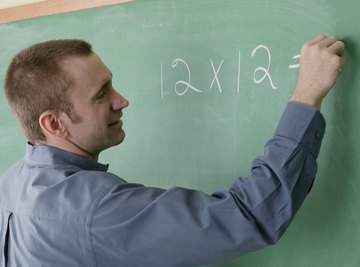
      Graduate to showing your students how they can write this on paper while you write the problems on the board. Use workbooks with addition and subtraction problems for practice. Also, find elementary math games to mix in with the more humdrum mechanics of learning math. Students need to know that math can be fun.

    • 4
      Remove the eggs.  Use candies instead.
      Remove the eggs. Use candies instead.

      Introduce your students to multiplication by showing them that multiplying is just a faster way to add. Use objects in an empty egg carton to illustrate multiplication. Fill some of the sections of the container with the same number of pieces of candy. If the problem that you want them to solve is 2 X 3 = 6, fill three compartments of the carton with two objects each. Then have students add each compartment to get the total. Explain that they just added 2 three times.

      As your students progress in their knowledge, multiplication tables must be memorized. It is essential that your students know them well. As they gain proficiency, use flash card games to practice giving the answers with speed.

    • 5
      Food is a great visual aid.
      Food is a great visual aid.

      Teaching division is easily demonstrated with food. Dishing up dinner or serving pie for dessert is an exercise in division that every child has witnessed many times over.

      Start your division unit by having a class party. Serve pizza and cans of soft drinks. Have the students help you out with the math. "If we have 12 slices of pizza and 6 people eating, how many slices can each person have?" As they give you the answer, show them on the board 12 divided by 6 equals 2. Do the same thing with the cans of soda.

      As you advance to teaching more traditional written and word problems for division, remind them, if they're struggling, of what they learned on party day.

    • 6
      Children should practice math at home every night.
      Children should practice math at home every night.

      Repeat the concepts regularly through homework assignments, seat work during class and mathematics games. Encourage parents to have their children do some practice problems and reciting of multiplication tables at home every night.

    • 7
      Test often.
      Test often.

      Give tests and quizzes often to keep a pulse on achievement. If at any time you detect that a fundamental process is not understood, or is fading away, briefly teach it again and give practice exercises.

Related Searches:

References

Resources

  • Photo Credit math image by jaddingt from Fotolia.com schulkind image by Tino Hemmann from Fotolia.com chldren teaching image by Julia Britvich from Fotolia.com colorful candies image by Piter Pkruger from Fotolia.com a dozen eggs image by davidcrehner from Fotolia.com pizza image by Claudio Calcagno from Fotolia.com homework image by Stepanov from Fotolia.com test image by multimartinator from Fotolia.com

Comments

You May Also Like

  • Research-Based Ways to Memorize Math Facts

    A mnemonic is any mental device that helps you memorize a particular piece of information. Mnemonics is derived from the word "Mnemosyne,"...

  • How to Practice Basic Math Facts

    Most parents want their children to do well in school, which makes it important to help kids practice basic math facts. Children...

  • How to Build Basic Math Skills

    Practicing and improving math skills is important throughout school, regardless of your grade level. Math concepts get increasingly difficult each year, and...

  • Basic Math Facts for Kids

    In the elementary grades, teachers expect students to study their basic math facts at home in order to improve the speed with...

  • Research Based Strategies for Teaching Multiplication Facts

    Research Based Strategies for Teaching Multiplication Facts. According to the Mathematics Education Research Journal, the ability to master basic mathematical ...

  • How to Teach Math Facts

    The process of teaching math facts is relatively simple and straightforward. It involves gradually moving children from the concrete (manipulating actual objects)...

  • How to Practice Basic Math Facts Online

    Basic facts establish the foundation for more complex math problems you will learn as you progress through school. Traditionally, basic facts are...

  • Compare Basic Math With Reform Math

    The controversy over basic and reform mathematics in public school systems, often called math wars, stems from the differences in learning content...

  • How to Write a Basic Research Paper

    Writing a research paper is relatively easy if you have a good topic and reliable information. Here's how.

  • How to Memorize Math Facts

    Memorizing math facts is the most important step to understanding math. Math facts are the building blocks to all other math concepts...

  • How to Teach Basic Facts Memory

    To become familiar with a subject, students must sometimes memorize basic facts. However, many students find memorization unpleasant, so teachers must work...

  • How to Teach a Child Math

    Teaching a child math is not as hard as you think. Whether you are a teacher, tutor or parent, some of these...

  • First Grade Math Subtraction Tables

    Comments. Video Transcript. Once your child has completely memorized his or her addition tables, only when they are completely memorized all the...

  • Research Based Math Manipulative Strategies

    The use of manipulatives in math teaching is based, in part, on the work of Jean Piaget, a noted figure from the...

  • How to Teach Kids Multiplication Facts

    Alongside addition and subtraction, multiplication is the one of the first fundamental mathematical operations children learn in school. This being said, some...

  • Effective Ways to Teach Basic Math Facts

    Effective Ways to Teach Basic Math Facts. Math facts, combinations of numbers 0 through 9 in all four operations, form one foundation...

  • Research Based Practices in Math Teaching

    Mathematics is one of the core subjects students are taught in school. As mathematics becomes more important in everyday life, professional educators...

  • How to Teach Basic Mathematics

    It is crucial that all children learn basic mathematics, but young people have different learning styles that make it necessary to tailor...

  • What Is a Research Journal Article?

    A research journal article is often times called a peer-reviewed article, and it comes from a journal that has peer reviewers check...

  • What Is the Meaning of Mathematics Proficiency?

    The National Research Council (NRC) performed an analysis on the meaning of mathematical proficiency, and issued a document in 2001 that outlines...

Related Ads

Featured