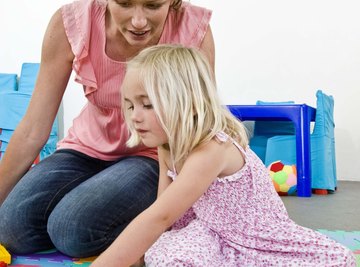
Many parents do not even realize they are teaching children numbers, quantities and counting through various daily activities. According to the Parenting Science, beginning math concepts start as young as 14 months of age, when a child knows if a container holds one, two or three objects. But connecting those amounts to physical numbers and learning to count takes a child somewhat longer. He will learn about math and numbers as you play with him.
Considerations
Give children time to learn. There is a big difference between a child understanding she owns three stuffed bears, her ability to count to three and her ability to point to each bear as she counts. She may not yet associate the fact that each item represents an increasingly higher amount. Let the preschool child learn at her own pace. Once she begins to count, she will quickly catch on to bigger numbers.
Concrete Items
A preschooler's brain has difficulty grasping abstract concepts, such as the association between a number and an object. That's why you will see parents almost intuitively touch or hold up fingers as they count. This process helps a child make the connection between saying the number "one" and holding up one finger. The child then begins to associate that counting crayons or pieces of cereal tells the quantity of those objects.
Rhymes and Songs
Rhymes and songs such as "One, Two, Buckle My Shoe," "One Potato, Two Potato" and "Five Monkeys on the Bed" incorporate numbers into songs. Singing further imprints the connection between numbers and quantities for your preschooler, especially if you incorporate whole body movement into the song. The activity of hearing the numbers and adding movement strengthens the connection of numbers, quantity and counting.
Worksheets
A preschool child can color numbers and papers before he even begins to write. Worksheets with large block numbers help him learn to color and to associate the number with a set of objects. He can also color and count objects as he colors. When he matures a little, he can begin to trace and copy numbers and relate them to quantities. The oldest preschoolers can work on color-by-number pages, with each number corresponding to a different color.
References
Photo Credits
Jupiterimages/Goodshoot/Getty Images