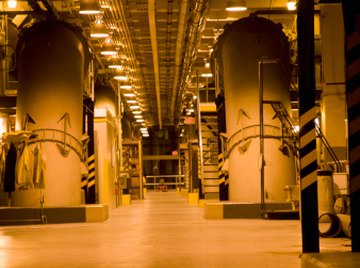

Many industrial processes require continuous aeration. Sewage treatment, for instance, uses aerobic microbes that respire constantly as they break down sludge. An industrial blower provides the necessary oxygen by maintaining a steady flow of air into the reaction chamber. You can estimate a blower's volumetric flow rate from the reactants' oxygen absorption rate. The other relevant factors are temperature and the pressure of air at the blower's discharge point.
Add 460 to the temperature at the discharge point, measured in degrees Fahrenheit, to convert it to degrees Rankine. If, for instance, air leaves the blower at 80 degrees: 80 + 460 = 540 degrees Rankine.
Multiply the Rankine temperature by the number of pounds-moles of oxygen that is transferred each minute. If, for instance, 8 pounds-moles of oxygen reach the reactants each minute: 540 x 8 = 4,320.
Multiply this product by 10.73, which is the gas constant: 4,320 x 10.73 = 46,354.
Divide the result by the pressure at the gas discharge point, measured in pounds per square inch. If this pressure, for instance, measures 15 pounds per square inch: 46,354 / 15 = approximately 3,090. This answer is the blower's volumetric flow rate, measured in cubic feet per minute.
References
Resources
About the Author
Ryan Menezes is a professional writer and blogger. He has a Bachelor of Science in journalism from Boston University and has written for the American Civil Liberties Union, the marketing firm InSegment and the project management service Assembla. He is also a member of Mensa and the American Parliamentary Debate Association.
Photo Credits
Thinkstock Images/Comstock/Getty Images