How to Identify Hornets & Wasps in Tennessee

How to Identify Hornets & Wasps in Tennessee thumbnail
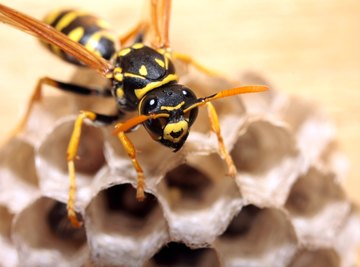
The yellow jacket wasp has either a black and yellow or black and white coloration.

Hornets are species of wasps. The difference between hornets and other species of wasps is that that prey predominately on other insects. Other wasp species play minor roles as pollinators of flowers and scavenge for food. Unlike bees that can only sting once, hornets and wasps are capable of stinging multiple times. Technically speaking, there is a single hornet species in North America, that being the brown hornet. You can find Eastern cicada killer wasps, the paper wasp, brown hornet and yellow jacket throughout Tennessee.

Things You'll Need

  • Binoculars
  • Wasp and hornet identification book
Show More

Instructions

    • 1

      Observe the thorax and abdominal segments of the wasp. Adult Eastern cicada killer wasps display reddish and black areas over their thorax. These wasps have black to reddish-brown markings and subtle yellow stripes on the abdominal segments. The brown hornet has reddish-brown markings in these areas and legs the same color as its abdomen. The paper wasp is also a reddish-brown color, but exhibits a yellow circle body marking. The yellow jacket has either a black and yellow or black and white coloration.

    • 2

      Look closely at the wings of the insect. The Eastern cicada killer wasps, which are frequently incorrectly identified as hornets, have brownish wings. The wings of the paper wasp are dark, whereas those of the yellow jacket wasp are a lighter color than those of the cicada wasps.

    • 3

      Take notice of the length and girth of the insect's body. The paper wasp has a slender body compared to hornets in general, and to the yellow jacket wasp specifically. The yellow jacket wasp has a definite waist, whereas that of the paper or umbrella wasp tapers at both ends. Neither the brown hornets nor the Eastern cicada killer wasps have very defined waists.

    • 4

      Observe where the insect has built its nest. Paper wasps choose to build nests in attics. You can find the nests of yellow jackets, Eastern cicada killer wasps and brown hornets outdoors.

    • 5

      Observe the overall size of the insects. The yellow jacket is up to an inch in length, while the brown hornet is slightly larger at over an inch in length. Eastern cicada killer wasps are considered to be one of the largest wasp species in Tennessee and can measure 1.5 inches in length. The paper wasps are relatively small, being just an inch in length.

Related Searches:

References

Resources

  • Photo Credit wasp image by Henryk Olszewski from Fotolia.com

Comments

You May Also Like

  • Stinging Wasps & Hornets in Tennessee

    Wasps and hornets do not have barbed stingers, so their stingers will detach if they sting once, and they are able to...

  • Hornet Species in Iowa

    Hornets belong to the family Vespidae, which includes all of the social wasps. They are similar to large yellow jackets and are...

  • How to Identify Different Wasps

    Wasps resemble ants with a slender body and narrow waist. They can be mistaken for bees from their similar size and color,...

  • Types of Bees, Wasps and Hornets

    Types of Bees, Wasps and Hornets. Due to their proclivity for delivering painful stings, bees, wasps and hornets are some of the...

  • Wasps & Other Flying Insects in Massachusetts

    Massachusetts is home to several different types of flying insects such as the lady bug, wood wasp, summer fruit tortrix moth and...

  • How to Identify Wasps & Hornets

    People might feel anxiety around flying insects that sting and might tend to group all flying and stinging creatures together under a...

  • Information on Hornets & Wasps

    In the environment, wasps and hornets are critical to the control of other insect species. Predatory wasps prey on caterpillars, flies and...

  • The Difference Between Wasps and Bees

    Wasps and bees are all capable of stinging people, but there are some very noticeable differences between the two. Wasps can sting...

  • Black Flower Wasps

    Black flower wasps (Discolia soror) belong to the wasp family Scoliidae. Black flower wasps are non-aggressive large insects that have stunning colored...

  • Insects That Eat Wasps

    There are about 75,000 species of wasps, of which almost all are parasitic. Those that are not parasitic build nests, both predatory...

  • How to Treat a Wasp or Hornet Sting

    The sting of a wasp or hornet is considered venomous. Quick removal of the stinger and proper follow-up care will help reduce...

  • How to Identify Large Wasps

    Identifying wasps becomes necessary at times to determine if the wasp living under the awning of your porch, in a nearby tree,...

  • How to Make My Own Wasp and Hornet Killer

    A wasp or hornet nest is a signifier of danger in your yard. Wasps and hornets work as a collective to protect...

  • How to Identify Black Wasps

    A black wasp is a predatory insect that is usually found around gardens and flower beds, especially those that have katydids in...

  • Cures for Wasps

    Wasps are beneficial insects, for the most part, but they are also predators. In late fall, the queens stop laying eggs and...

  • Wasp & Hornet Identification

    Wasps and hornets are beneficial insects to have in the garden, and knowing which ones you have can help you cultivate them...

  • Characteristics of a Yellow Jacket Wasp

    The yellow jacket wasp ranges in size from 1/2-inch to 5/8-inch in length. Its colors are yellow and black with a tiny...

  • How to Kill European Hornets

    European hornets are large and intimidating. Their stings are painful and can cause an allergic reaction in some people. They are up...

Related Ads

Featured