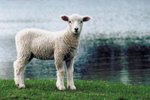
Originally developed in Australia and New Zealand in the late 19th century, the Corriedale sheep is a dual-purpose breed, suitable for fleece and meat production. A cross between the Merino and Lincoln breeds, the modern Corriedale imparts hybrid vigor when bred to other types of ovines.
Appearance
Born naturally polled, or without horns, this sheep sports horizontal ears, sometimes with blue or black spotting. The Corriedale's face lacks wool. The rest of the body makes up for that, as the wool is particularly dense. At maturity, large-framed Corriedale ewes weigh between 130 to 180 pounds, with rams ranging from 175 to 275 pounds. The breed boasts deep ribs, broad backs, well-muscled hindquarters, thick leg bones and dark hooves. A heavy carcass weight adds to their value as a meat breed.
Fleece
Corriedale sheep sport a dense, semi-lustrous medium-fine fleece. It's especially in demand for felt production and popular with hand spinners. Fleece colors include silver, fawn, brown and black. The typical mature ewe provides between 10 and 17 pounds of fleece at each shearing, with an yield percentage of usable fleece ranging between 50 and 60 percent. Corriedale fleece quality includes considerable length evenness.
Breeding
Corriedale ewes mature earlier than other types of sheep, so can be bred earlier. Not only are Corriedales good mothers, but they often give birth to multiple lambs. According to the Australian Corriedale Association, lambing exceeds 100 percent, with lamb survival rates of up to 140 percent in a flock. That means that because many ewes produce two or more lambs with each pregnancy, the average lamb survival rate exceeds one lamb per ewe for the entire flock. Lambs gain weight quickly and are quite active from birth. Corriedale rams also are in demand for crossing with ewes of other breeds.
Hardiness
Corriedales are an exceptionally hardy, long-lived breed, renowned for their strong constitutions. They do well in hot and cold climates and are found throughout the world. Feed efficiency is one reason for their popularity -- they gain weight on far less food than other breeds. They're known as a docile, easily maintained breed. The Australian Corriedale Association describes these sheep as "good doers in poor seasons."
References
Writer Bio
Jane Meggitt has been a writer for more than 20 years. In addition to reporting for a major newspaper chain, she has been published in "Horse News," "Suburban Classic," "Hoof Beats," "Equine Journal" and other publications. She has a Bachelor of Arts in English from New York University and an Associate of Arts from the American Academy of Dramatics Arts, New York City.