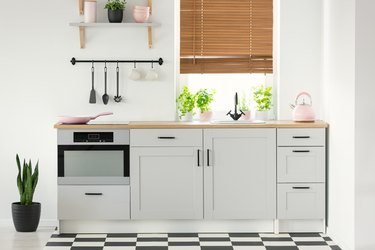
Adding a checkerboard pattern to a wall, floor, or tabletop creates a beautiful accent in the room. While the pattern looks simple, it's a time-consuming design to paint, especially over a large space, such as a big accent wall or the floor of a large room. The process involves measuring, marking, and taping lines and then moving the tape lines to get the squares perfect.
Choose Two Paint Colors
Video of the Day
A traditional checkerboard pattern uses two colors, typically one light and one dark. Black and white is a classic combination, but you can choose any two colors that work well together. For a subtle checkerboard pattern, choose a lighter and darker version of the same hue. A gingham pattern is similar, but it adds a third color. This option takes even more steps since you have to paint the different colors separately.
Video of the Day
Start With the Light Color
The easiest option is to prime the surface and do two coats or more of your lighter color over the entire wall, floor, or table. Do enough coats to get adequate coverage just as you would if you were painting the wall all one color. This takes care of those lighter-colored squares without any extra painting or taping for those areas. You'll want to wait a minimum of four hours, but waiting overnight gives the paint more time to dry well before you start marking on it and sticking tape to it.
Measure and Mark the Squares
Decide how large you want your squares to be for your checkerboard pattern. Grabbing a tape measure to measure the length and width of the space you're painting can help you find the exact measurements for your squares. You might need to adjust the size by a few inches to fit the space well. If your measurements don't work out perfectly to have an exact number of squares across the wall, start in the center and work out, making the corner squares slightly smaller.
Measure and mark each square using a level and a pencil to sketch out the squares. Step back to ensure the squares look equal and straight, making adjustments as necessary. Continue across the entire surface to create every square you'll paint.
Tape and Paint
Taping the squares for your checkerboard motif can be tricky. Your painter's tape adds width, so it should go outside the squares you're painting the second color. Since every other square will be the second color, you'll have to think strategically about placing the tape. To make it easier, put a small 1-inch piece of painter's tape inside the squares that will remain the base color so you can easily identify which squares will be painted.
You'll start by painting the squares in the second color of every other row. Place a horizontal piece of painter's tape along the top edge of the first row you want to paint. Then, press tape along the bottom edge of that row, being sure the painter's tape goes below the squares you'll paint and not into it. Then, place the vertical tape pieces the same way, pressing firmly to ensure the second color doesn't leak into the base color.
Paint the squares on every other row in the second color. Do two or more coats as needed to get good coverage. Let it dry completely before moving on to the next set of squares. Remove all of the painter's tape from this set of squares.
Move the Tape and Paint
Now, you'll put new tape lines vertically and horizontally for the dark squares in the opposite rows from what you painted last time. Again, place the tape edge along the line for the dark squares so the rest of the tape sits outside the squares you're going to paint. Paint the remaining dark squares with two or more coats of paint and remove the tape. You might need to do some touch-ups along the edges of the squares if any of the paint bleeds under the tape.