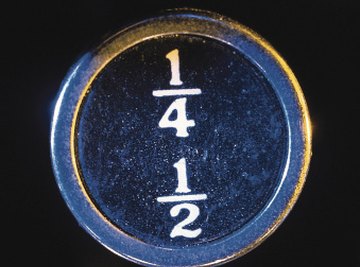

A fraction is a division of a whole number, divided into a top half (numerator) and bottom half (denominator). Proper fractions represent values between 0 and 1, e.g. "3/4" and "2/3." Improper fractions can represent any whole number or division of whole numbers, e.g. "5/4." Mixed fractions also can represent any fractional value, and they are written with whole numbers next to proper fractions. "2 1/4" -- or two and one-fourth -- is a mixed fraction. Putting fractions on a number line can help you visualize the number they represent.
- Pencil
- Paper
- Ruler
Keep all of your conversions in one place so you can show your work.
Convert any mixed fractions into irregular fractions. Multiply the denominator of the faction by the whole number, and add it to the numerator. The resulting answer is the numerator of the corresponding irregular fraction, and the denominator is the denominator of the mixed fraction. For instance, the "2 1/3" mixed fraction becomes the "7/3" improper fraction, as 2 x 3 = 6 and 6 + 1 = 7.
Find a common denominator for all fractions. List multiples of each denominator; e.g. "3, 6, 9, 12, 15" for "3" and "5, 10, 15" for "5." Find a multiple that they all share, preferably the lowest number; this will be your common denominator. For instance, "15" is a common denominator for "2/3" and "4/5."
Convert each fraction to an equivalent fraction with the common denominator. Divide the common denominator by the denominator of the fraction, then multiply the numerator of the fraction by the result. The conversion will contain the result of that calculation as the numerator and the common denominator as the denominator.
Determine the range of your number line. Regular fractions require only a range of 0 to 1. Irregular fractions will require an upper bound larger than your largest fraction. For instance, if the largest fraction was "1 3/4" the upper bound could be "2."
Draw the number line. Use the ruler to draw a straight line, then mark the left side with the lower bound of the number line and the right side with the upper bound. Segment the line by whole numbers, if applicable. Below the number, write the corresponding improper fraction. For instance, if your number line goes from 0 to 2 and your common denominator was 4, you would draw a line, label the left side "0" and the right side "2." Then you would mark the center and label it "1." Then you would write "0/4" beneath the "0," "4/4" beneath the "1" and "8/4" beneath the "2."
Segment the number line. For each whole number segment, divide the line into a number of segments equal to the common denominator. Label each division by the fraction it represents. For example, if your common denominator was 4, each whole number segment would be divided into four segments of equal length.
Write each fraction at the corresponding division of the number line. For instance, "5/4" is placed at the "5/4" mark, which is the first mark after "4/4."
Things You'll Need
Tips
References
Tips
- Keep all of your conversions in one place so you can show your work.
About the Author
Amber Viescas is a 23-year-old freelancer who has been writing since 2009, penning articles for sites such as Nu Home Source. She has a Bachelor of Arts in computer science from Swarthmore College and has co-published a paper in the "Journal of Parallel and Distributed Computing."
Photo Credits
Comstock Images/Comstock/Getty Images