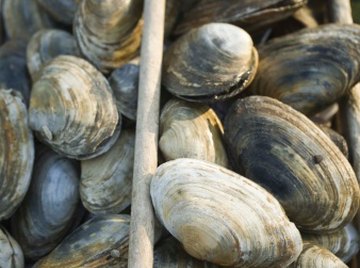
It's not easy to determine the gender of clams because they offer none of the visual cues associated with many other species. There is no size difference between males and females, no difference in color and no active mating behavior for an observer to monitor. For students and scientists working with individual specimens, dissection and microscopic examination is the only reliable gender diagnostic. In aquaculture, where large numbers of the molluscs are raised, their gender is determined by closely monitoring their spawning behavior. Two methods are described here: observation and dissection.
Observation
Fill a shallow, transparent tray or tank with fresh seawater. In late afternoon or early evening, warm the water to 75 degrees and place a number of clams in the tray.
Space the clams evenly so the water around each one can be clearly seen. Keep the light low but bright enough that you can see any changes in the water.
Watch the clams. They spawn primarily at night, with males releasing sperm first. When you see the water begin to cloud around some of the clams, you will know these are the males.
Separate the males into another container of fresh seawater. They will continue spawning in the second container, and the females will do so later in the original container.
Dissection
Insert a scalpel at the hinge, where the two halves of the shell join. Cut through the muscles holding the shell closed. Lift off the top shell.
Slice away the upper half of the clam's mantle, making a shallow horizontal cut. Lift away the mantle to reveal the organs underneath.
Locate the intestine, a small curly tube. One end will be attached to the digestive organ. The only other organ of comparable size will be the gonad, which is not attached to the intestine but is located underneath it.
Lift away the intestine and remove a thin section of the gonad. Wet mount the sample of gonadal tissue on a microscope slide and examine it under a compound microscope. Either sperm or eggs should be clearly discernible, identifying the specimen either as male or female.
References
- University of Maryland Aquaculture Center; Softshell Clam Culture: Hatchery Phase, Broodstock Care through Seed Production; Joseph K. Buttner, et al.; 2010
- Southern Regional Aquaculture Center; Biology and Culture of the Hard Clam; Jack M. Whetstone, et al.; August 2005
- Sea Coast Online; Clams: The Wonder of Their Reproduction; Sue Pike; June 2009
About the Author
Fred Decker is a prolific freelance writer based in Atlantic Canada, where he grew from the kind of kid who read his encyclopedia for fun to the kind of adult who reads academic papers for fun. He was educated at Memorial University of Newfoundland and the Northern Alberta Institute of Technology. Aside from Sciencing, his articles on science and food science have appeared on major sites including eHow, Livestrong, TheNest, Leaf.TV and SFGate.com.
Photo Credits
Jupiterimages/Brand X Pictures/Getty Images