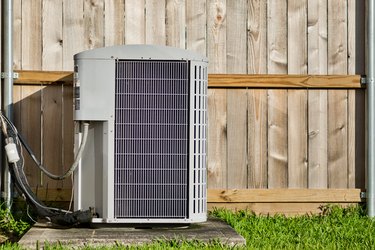
HVAC tonnage describes an air conditioner's cooling capacity and is measured in BTUs. Knowing the amount of tonnage you need is important when buying a new central air unit. A correctly sized heat pump or central air conditioning system can save money and make building interiors more comfortable for occupants. A system that is either too small or too large may not provide adequate cooling and may have a shorter life. It can also result in increased energy costs.
For Rough Estimation Only
Video of the Day
Calculating the proper tonnage accurately requires you to consider a variety of factors, including climate, number and size of windows, ceiling height, number of occupants, foundation type and amount of insulation. Professionals use a complex formula to determine the correct size of a cooling system, but there is a simpler method that can be used to get a "ballpark" estimate. Before purchasing a system, however, it is best to have a professional compute the tonnage.
Video of the Day
HVAC Terminology Used
Heating and cooling professionals typically use the following terms:
- British Thermal Unit: Commonly abbreviated as Btu or BTU. One BTU represents how much heat is needed to increase the temperature of 1 pound of water at sea level from 58.5 degrees Fahrenheit to 59.5 degrees Fahrenheit. It is normally expressed by contractors in terms of BTUs per hour.
- Tonnage: In reference to air conditioning, a ton measures how much heat removed by the system would be needed to melt 2,000 pounds, or one ton, of ice in a 24-hour period. The result is then expressed in BTUs per hour. According to the standard calculation, it takes 288,000 BTUs to melt a ton of ice in 24 hours, or 12,000 BTUs per hour. Therefore, 12,000 BTUs per hour equal 1 ton of cooling.
Although window units are typically rated in BTUs, heat pumps and central air conditioning systems are almost always rated in tonnage.
How to Estimate Tonnage Required
Step 1: Calculate Square Footage
Determine the square footage of the area to be cooled. The sales contract or home's blueprint may show this information. Otherwise, measure the length and width of each room with a tape measure, multiply these measurements to get the square footage, and add the square footage of each room together. Alternatively, you can take the exterior measurements of the entire house and subtract the square footage of any area that will not be cooled, such as an attached garage.
Step 2: Multiply to Get BTU Value
Multiply the square footage by 25 to obtain the base BTU value. Add 400 BTUs for every occupant and 1,000 BTUs for every window or exterior door. The result is the total BTU value.
Step 3: Divide by 12,000
Determine the estimated tonnage by dividing the total BTUs by 12,000.
An Example Calculation
To calculate the estimated tonnage for a house with 2,000 square feet, 15 windows and three exterior doors, occupied by five people:
2,000 x 25 = 50,000 base BTUs
5 people x 400 = 2,000
15 windows x 1,000 = 15,000
3 exterior doors x 1,000 = 3,000
50,000 + 2,000 + 15,000 + 3,000 = 70,000 BTUs
70,000/12,000 = 5.83 estimated tons required
This calculation does not include features that might reduce the required tonnage, such as insulation or energy-efficient windows. Therefore, a professional calculation might show a lower requirement.
Many contractors use a rough estimate for HVAC systems of 1 ton of air conditioning for every 400 square feet. Although this calculation is often inaccurate, using it for comparison purposes might help you catch math errors. To illustrate, using this method, a house with 2,000 square feet would need a 5-ton unit. If other calculations indicate the need for a 0.5-ton or 50-ton unit, it is a sign that there is an error in the calculation.