
What does fact checked mean?
At SportsRec, we strive to deliver objective content that is accurate and up-to-date. Our team periodically reviews articles in order to ensure content quality. The sources cited below consist of evidence from peer-reviewed journals, prominent medical organizations, academic associations, and government data.
The information contained on this site is for informational purposes only, and should not be used as a substitute for the advice of a professional health care provider. Please check with the appropriate physician regarding health questions and concerns. Although we strive to deliver accurate and up-to-date information, no guarantee to that effect is made.
Resistance Band Exercises for Trapezius
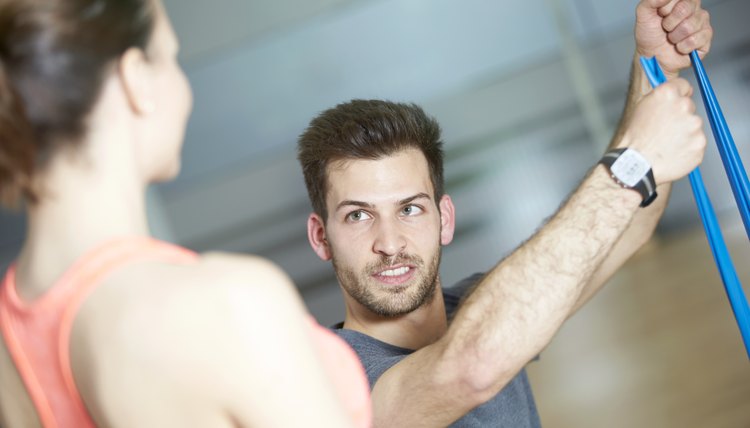
The trapezius is a large muscle that spans the shoulders, upper back and the neck. Repetitive motions related to using the phone or sitting at a computer for several hours at a time and some sports activities can cause pain or tightness in the trapezius muscle. Resistance band exercises can help strengthen the trapezius to ease muscle discomfort.
Reverse Fly
The reverse fly will work the middle and lower trapezius, rhomboids, teres minor, lateral deltoid, infraspinatus and the posterior deltoid. Place the resistance band onto something immobile, such as a door or a beam, and stand in front of the band and grab an end in each hand with the arms straight out in front of the body at shoulder height. Pull each end of the band out to the sides of the body and then return to the starting position to complete a repetition. Do two sets of 15 reps.
Seated High Row
The seated high row targets muscles all over the body, but the general target is the muscles in the upper back and the backs of the shoulders, including the middle trapezius and lower trapezius. Secure the resistance band onto something in front of the body, such as a beam or a pole, and then sit on the ground in front of it. Hold an end of the band in each hand and then keep the back straight as you move your torso backward to pull the band toward the body. Complete two sets of 15 reps.
Kneeling Reverse Fly
The kneeling reverse fly will target the muscles in the shoulders and the muscles in the upper back. Kneel down on something comfortable like a mat and then engage the abdominal muscles to ensure proper form throughout the exercise. Start with the arms extended out in front of the body at shoulder height and the hands together. Pull the arms out and down to the hips and then return them to the starting position. Keep the arms straight the entire time. Do two sets of 15 reps.
Shoulder Press
The shoulder press will work the trapezius, shoulders and the triceps. Start by standing on the band with the legs shoulder-width apart. Hold an end in each hand and position your palms so they are facing away from the body. Bring the ends of the resistance band up over the head by extending the arms out in front and then bringing them up, and then return to the starting position. Try to complete two sets of 15.
References
- IDEA Health and Fitness Association: Helping Upper Trapezius Pain
- ExRx.net: Cable Reverse Fly
- ExRx.net: Cable Seated High Row
- ACE Fitness: Kneeling Reverse Fly
- Ourieff J, Agarwal A. Anatomy, Back, Trapezius. [Updated 2018 Dec 6]. In: StatPearls [Internet]. Treasure Island (FL): StatPearls Publishing; 2019 Jan-. Updated December 6, 2018.
- Terson de paleville DG, Mckay WB, Folz RJ, Ovechkin AV. Respiratory motor control disrupted by spinal cord injury: mechanisms, evaluation, and restoration. Transl Stroke Res. 2011;2(4):463-73. doi:10.1007/s12975-011-0114-0
- Kamali F, Sinaei E, Morovati M. Comparison of Upper Trapezius and Infraspinatus Myofascial Trigger Point Therapy by Dry Needling in Overhead Athletes With Unilateral Shoulder Impingement Syndrome. J Sport Rehabil. 2019;28(3):243-249. doi:10.1123/jsr.2017-0207
- Kamali, F. Comparison of Upper Trapezius and Infraspinatus Myofascial Trigger Point Therapy by Dry Needling in Overhead Athletes With Unilateral Shoulder Impingement Syndrome. J Sport Rehabil. Jan 2018.
- Kendall, Florence, McCreary, Elizabeth Kendall, Provance, Patricia Geise. Muscles Testing and Function 4th ed. Williams and Wilkins. Baltimore, Maryland, 1993.
Writer Bio
AJ Carpenter has a bachelor's degree in P=physical education and a master's in Journalism from Missouri State University. He has written for various publications on topics ranging from health and fitness to education and gardening.