Things You'll Need
Knitting pattern
Knitting machine
Yarn (center wound or on a cone)
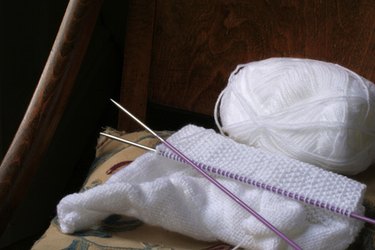
Machine knitting is a quick and easy way to make a knitting project in a couple of hours instead of days or weeks. Even for experienced knitters, knitting machines can prove to be a difficult transition. With different mechanical dynamics and hundreds of moving parts, knitting machines can be a bit intimidating. One benefit that stands out is that basic knitting patterns do not need any adjustment to transition to a knitting machine. Using a simple, standard stockinette pattern that does not call for cables, short rows, bobbles or other advanced knitting stitches can make your transition from hand knitting to machine easy.
Step 1
Prep your yarn by making sure that it is wound from the center. A skein will not be able to let the yarn flow fast enough to feed the machine's demand for yarn.
Video of the Day
Step 2
Pull out the number of stitches that your pattern calls for on your machine. You needn't make any adjustments unless there is a purl stitch required for ribbing. For a purl stitch, skip a knitting key. You will make your purl stitches later. For now, put on your cast on comb or, in the case of an Incredible Sweater Machine, the elastic strand cast-on comb, and thread the yarn through the carriage. Push the carriage across the machine bed starting your first row.
Step 3
Push your carriage back and forth until you have finished the desired amount of length for your ribbing. Taking your latch tool or a simple crochet hook, work in your purl stitches by chaining up the ladder of stitches that have been left by your skipped needle slots. Place the last stitch of each one of these rows onto the corresponding knitting key and continue knitting by pushing the carriage back and forth until you reach the desired length for your piece.
Step 4
Cast off by passing the carriage over the knitting without any yarn through the feeder being sure to hold your knitting up so it does not fall to the ground or become unraveled by the weight of your cast on comb.
Step 5
Pull out a length of yarn that is three times longer than your knitting and use a crochet bind off to end the row. This will make a beautiful neat edging that will prove very easy to sew or remove if needed.
Tip
To make a simple center-wound skein, put the first few inches inside of an empty prescription bottle and wind the yarn around the bottle until you've gone through the whole skein. If you plan on doing a great deal of machine knitting, a yarn winder is a very good investment. Your local yarn shop will wind your skeins for you for free on their winder if you ask. It is in good form to make sure the yarn was purchased at the shop. Your local yarn store will also carry skein winders that are reliable and cheap.
Warning
Watch carefully for dropped stitches. With the cast on comb pulling down the knitting, slipped stitches can unravel fast. If so, simply use the latch tool or a crochet hook to work up the column of stitches until you are back at the machine bed and can slip the stitch back onto its corresponding hook.
Video of the Day