How to Pattern a Wood Floor
Much like assembling a jigsaw puzzle, the installation of a commercial wood floor is relatively simple. The wood planks and strips are straight and the sides have a tongue-in-groove application to snap them together on an even plane. Modern technology underlay, "intelligent" adhesives, and pre-finished wood planks have taken much of the guesswork out of the process. If you have decided to make a very intricate pattern, or incorporate inlays and medallions into your floor design, it is wise to draft your plan on paper before you start gluing. Does this Spark an idea?
Things You'll Need
- Wood planks and/or strips
- Rubber hammer
- Wood floor adhesive
- Wood stain (optional)
- Wood varnish (optional)
- Pencil (optional)
- Draft paper (optional)
- Tracing paper (optional)
- Ruler (optional)
Instructions
-
Parallel Pattern
-
1
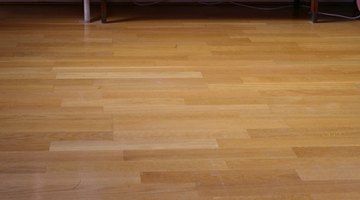
Clean lines give a simple, neat appearance. Install planks end-to-end starting at the most visible point upon entering the room.
-
2
The horizontal lines of this floor balance the vertical lines of the walls. Cut the final plank to the correct size so that it fits into the last space before the wall.
-
-
3
The tongue-in-groove system of commercial wood floors facilitates installation. Install another row in the same manner using a rubber hammer to lightly tap wood planks into place when necessary. Continue the process until the floor is completed.
Random Parallel Pattern
-
4
Random parallel lines create energy and movement. Lay one row end-to-end in the parallel format.
-
5
Wood stain will highlight the spontaneous natural patterns in the wood. Cut the starter plank in the next row a different length than the length of the starter plant in the previous row. Also consider using varying plank widths.
-
6
Protecting the wood with varnish will add luxury and shine. Continue to vary the length of the starter plank for each row until the room is finished.
Diagonal Pattern
-
7
A diagonal pattern gives a touch of luxury to an otherwise ordinary room. Install two rows of planks end-to-end diagonally across the middle of the room. Cut the starter and end pieces of each row at the angles necessary to fit the triangular shape where two walls meet.
-
8
Lay another row of planks against the the initial ones in the same manner as in the parallel format. Cut the pieces at 45-degree angles at the beginning and end of each row to fit along the walls.
-
9
Continue to install and cut as necessary.
Herringbone Pattern
-
10
This herringbone pattern requires cutting each strip at both ends. Decide whether you prefer a 45-degree or a 90-degree herringbone pattern. The 45-degree pattern will require that the planks be cut at 45-degree angles at either end. The 90-degree pattern requires no cutting.
-
11
This simpler herringbone pattern requires no cutting. Position two planks together in a 45-degree or 90-degree angle, depending on which pattern you have chosen. Place them as close to the wall as possible without invading the perimeter space. Glue the planks into place.
-
12
Install the rest of the planks using the base planks to guide you. Do not be concerned if there are gaps between your patterned floor and the walls. Cut wood pieces to fit into the gaps left near the walls to obtain a perimeter line parallel to the wall.
Reiterating Pattern
-
13
Staining the wood in varying shades can be used to create a 3-D effect. Lay pieces of wood in different configurations using your creative intuition until you achieve the look you desire. This activity is particularly fun with parquet strips. Consider combining pre-stained wood lighter and darker shades.
-
14
Parquet floor designs are commonly inspired by other things. Glue the finished design to the foundation.
-
15
This is called the basket weave pattern. Use the initial patterned section as a guide to finish installing the rest of the floor.
Inlays and Medallions
-
16
Although this is a wooden inlay table, a wood floor can be just as intricate. Draft a scaled down version of the room´s floor plan onto paper. Draw your desired floor design to scale on tracing paper laid over the floor plan. You can draw various designs to place on top of the floor plan until you decide which you like best.
-
17
Wood strips can be cut into any shape. Create a life sized stencil and cut wood pieces for medallions or irregular pattern images. Medallions and inlays are also available commercially.
-
18
An interesting bidirectional pattern separated by a feature strip inlay. Install the image at the exact location you have chosen in the room and lay rest of wood planks around it, cutting them as necessary to fit.
-
1
Tips & Warnings
Stain and varnish the floor if desired following the instructions of the manufacturer. Staining brings out the rings, knots and imperfections in the wood for a rustic effect. Varnish protects the wood and adds a luxurious shine.
Always leave a ¼-inch perimeter space between wall and floor planks to prevent buckling from expansion of the wood due to climate changes. The perimeter space is disguised with a wood border trim.
References
Resources
- Photo Credit Historic Bedroom in Stately Home image by Ken Marshall from Fotolia.com guest room image by monamakela.com from Fotolia.com bedroom image by Adrian Hillman from Fotolia.com textura-218 image by Paco Ayala from Fotolia.com Parquet floor image by Einar Bog from Fotolia.com Wooden texture to serve as background image by Viacheslav Anyakin from Fotolia.com Parquet en bois ciré image by Bruno Bernier from Fotolia.com Youthful living room interior image by Paul Hill from Fotolia.com the wooden parquet image by Sobolev Andrey from Fotolia.com parquet image by Roman Sigaev from Fotolia.com It shines image by Yuriy Rozanov from Fotolia.com wood pattern image by BigDog from Fotolia.com texture of wooden floor image by Elnur from Fotolia.com la table image by xavier guichard from Fotolia.com Hems image by Yuriy Rozanov from Fotolia.com desk, lamp and hours image by terex from Fotolia.com