
How do I Make a Small Scale Tesla Coil?
Tesla coils are high-frequency, air-core transformers, which step up voltages to several hundred thousand volts. They can be built in sizes ranging from low-power units a couple of feet high to forty-foot columns that generate lightning-sized discharges. Tesla coils have few components and the exact component characteristics are not critical, so they are easy to build. While more complex units are more efficient and better tuned for higher performance, a basic coil can be put together from just a step-up transformer, capacitors and primary and secondary coils, which can be wound by hand.
Things You'll Need
- Plywood, about 2' x 2', 3/4" thick
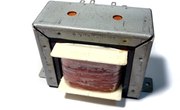
- Step-up transformer, 120V to about 15KV
- Quarter inch copper tubing, 30 ft.
- Capacitors, total rating 0.01 microfarad at 30KV
- Cardboard mailing tube, 4" diameter
- AWG #26 enameled solid copper wire (magnet wire), 1000 ft.
- AWG #10 insulated solid copper wire, 20 ft.
- Top electrode, ideally a toroid but can be any smooth, metal object
- Two 6 inch lengths of 1/2 inch copper pipe with fasteners
- Construction glue, for example mirror or tile adhesive
Instructions
-
Build a Small Tesla Coil
-
1
Place the step-up transformer on the top-left corner of the plywood. Ignition transformers from oil furnaces or transformers from neon signs can be used. The transformer will have holes or fasteners which can be used to screw or bolt it to the plywood.
Screw four pieces of scrap lumber under the four corners of the plywood to raise it slightly. Four-inch pieces of 2 by 4 screwed on flat will work well.
-
2
Build the primary coil. Make a flat spiral from the copper tubing. The inner diameter should be 6 inches and the space between the turns should be about 1/4 inch. After completing the final outside turn, leave a straight length of about 6 inches Place at the top, right corner of the plywood with the straight length along the edge, pointing toward the transformer. Drill a 1/4-inch hole into the plywood near the end of the tube at the inner end of the spiral. Bend the end of the tube through the hole. Glue into place.
-
-
3
Build the secondary coil. Poke a hole into the mailing tube about 1 inch from one end and thread the end of the magnet wire through, leaving about 6 inches loose. Wind the 1000 feet of wire tightly onto the tube. When finished, cut the excess tube off, poke a hole near the end and thread the end of the wire through it. Place the covers of the mailing tube on each end so that the wires stick out but are jammed in place. Varnish the tube to keep the wire in place and for extra insulation.
Drill a small (about 1/16") hole in the center of the primary coil. Place the secondary coil in the center of the primary coil poking the wire from the bottom end of the secondary coil through the small hole. Glue the coil into place with a bead around the bottom and glue the wire in place under the plywood. Place the top electrode on top of the secondary coil and connect to the coil wire there.
-
4
Assemble the capacitor bank on the bottom left corner of the plywood. To get an aggregate capacitance of about 0.01 microfarad and a voltage rating of 30 KV, a number of capacitors must usually be connected in series. For capacitors connected in series, the voltages add and the capacitance is divided by the number of capacitors in series. Capacitors may be rated 3KV and 0.1uF. Putting ten in series will give 10 * 3KV for a 30 KV rating and 0.1uF/10 for a capacitance of 0.01uF.
-
5
Mount the spark gap. Squeeze or hammer one end of each copper pipe shut; create a straight seam. Place the two lengths of copper pipe on scrap bits of lumber and screw down with fasteners so that the lengths of pipe stick out from the lumber at least three inches with the seam on the part which sticks out. Four inch lengths of 2 x 4 will work well.
Screw the lumber to the plywood near the bottom, right corner so that the two lengths of pipe are in line and the parts that stick out are almost touching. Loosen the copper pipe fasteners and rotate the pipes so that the seams are vertical, and move the pipes for a gap of about 1/4 inch.
-
6
Wire up the components using the #10 wire. Bend it into shape, glue in position, and solder to connect. Wires should not cross or run close together and they should be kept as short as possible.
Connect the ground of the step up transformer secondary under the plywood to the coil wire. Connect one end of the transformer high voltage winding to the straight length of copper tubing at the top of the plywood. Connect the straight copper tubing to the right end of the spark gap.
Connect the other end of the step up transformer high voltage winding to one end of the capacitor bank and connect it through holes under the plywood to the left side of the spark gap. Connect the other end of the capacitor bank under the plywood to the end of the copper tubing poking through the hole.
-
7
Place the tesla coil in an open space far from any grounded or conducting material which might be damaged by the discharges. Plug the low voltage winding of the step up transformer into a switched outlet. Switch on the tesla coil. If there is no spark, switch off and move one of the copper pipes slightly to decrease the gap. Observe the streamers from the top.
It is probably possible to improve the performance of the coil by tuning it. To tune by trial and error, short circuit parts of the primary coil by placing a small length of copper tubing across the outside winding(s) of the primary coil. Short circuiting one or more windings changes the inductance and may allow the tesla coil to generate longer streamers. The spark gap should always be adjusted to the maximum size which will still generate sparks.
-
1
Tips & Warnings
All parts of the Tesla coil operate at high voltages when the coil is switched on. These voltages can cause deadly electric shock and severe burns for anyone who comes in contact with them and can cause explosions and fire. Observe the Tesla coil operation from a safe distance of at least 20 feet initially, and always switch it off and discharge the capacitors before working on the coil.
References
Resources
- Photo Credit lightning 54 image by chrisharvey from Fotolia.com