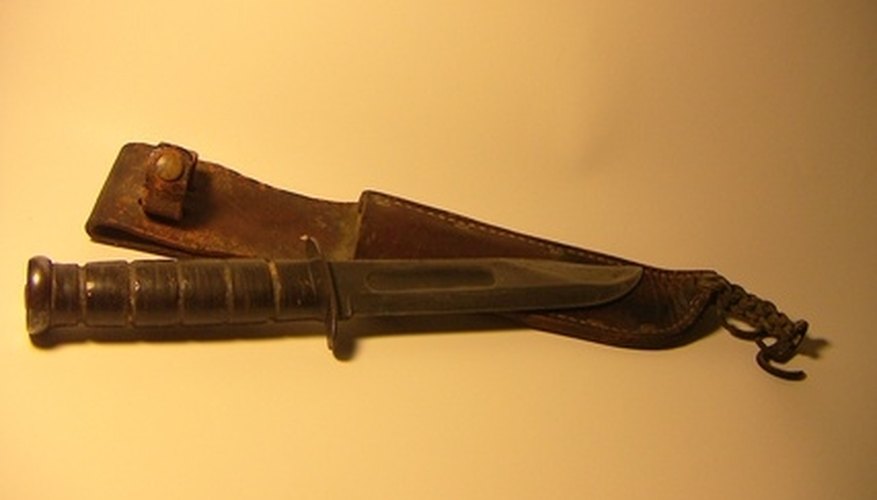


The Kabar is the knife commonly associated withe the U.S. military, particularly the Marine Corps. The Kabar company approached the Marine Corps during World War II to produce a military fighting knife, and after altering the original design, came up with the design that we recognize today as the Kabar. In order to use a Kabar knife effectively, you have to be trained in close combat with deadly weapons, and quickly be able to adapt to any fighting situation. Basic techniques should always be backed up by appropriate combat instruction.
Take a fighting stance. Position your body squarely in front of your opponent, with the foot opposite your dominant hand out in front. Keep your non-dominant hand up near your head and neck in order to fend off a possible blow.
Hold the Kabar knife in your dominant hand; use a tight fist with the arm bent at the elbow and the tip of the knife pointing at the opponent's head. This is known as the hammer fist; it will keep the knife secure from being knocked away
Strike your opponent on the closest body part available or readily exposed within your striking distance. If your opponent has a knife, strike at the hand holding the knife with a quick downward slashing motion.
Aim for soft tissue areas in a close thrusting motion while pivoting away from your opponent's knife hand. Aim for areas near vital organs and main arteries. These areas include the region below the sternum, neck, liver, kidneys, and the femoral, carotid and aortic arteries.
Pivot continuously away from your opponent's striking hand while trusting and slashing at available soft tissue or vital organ targets.
Warnings
- Note that knife combat is extremely dangerous and can result in death or serious physical injury. Proper close combat training and practice should be sought out when attempting to learn knife combat techniques.
References
Warnings
- Note that knife combat is extremely dangerous and can result in death or serious physical injury. Proper close combat training and practice should be sought out when attempting to learn knife combat techniques.