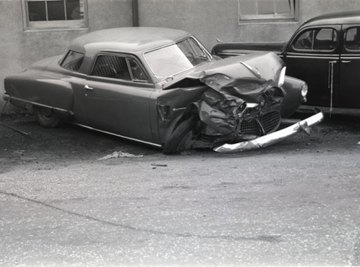

When two objects collide, their total momentum does not change. The total momentum, before and after the collision, equals the sum of the objects' individual momenta. For each object, this momentum is the product of its mass and its velocity, measured in kilogram meters per second. If the objects move in opposite directions before the collision, the opposing velocities will partially cancel one another out. After the collision, when the objects remain joined, they'll move together with their combined momentum.
Multiply the first object's mass by its velocity. For example, if it weighs 500 kg and travels at 20 meters per second, it has a momentum of 10,000 kg meters per second.
Describe the second object's velocity in terms of the first object's direction. For example, if the first object travels at 30 meters per second in the direction opposite to the first object's direction, multiply this velocity by -1, giving the second object a velocity of -30 meters per second.
Multiply the second object's mass by its velocity. For example, if it weighs1,000 and has a velocity of -30 meters per second, then its momentum will be 30,000 kg meters per second.
Add the two velocities together to determine which way the objects will move after collision. For example, a collision between an object with a momentum of 10,000 kg meters per second and an object with a momentum of -30,000 kg meters per second gives a result of -20,000 kg meters per second. A negative result means the objects will move in the second object's original direction after the collision.
References
Resources
About the Author
Ryan Menezes is a professional writer and blogger. He has a Bachelor of Science in journalism from Boston University and has written for the American Civil Liberties Union, the marketing firm InSegment and the project management service Assembla. He is also a member of Mensa and the American Parliamentary Debate Association.
Photo Credits
George Marks/Retrofile/Getty Images