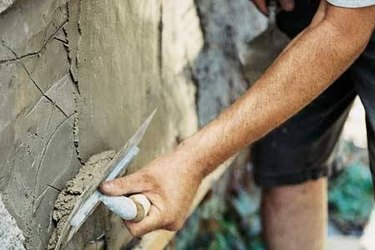
Usually people just buy ready-mixed stucco, but you can certainly make your own. With just a few materials, you can make a batch of stucco to use for your backyard project. Make sure you get your eye and hand protection because you don't want to have the alkaline stuff get all over you. This is a simple but effective method of making stucco.
Step 1
Pour one five-gallon bucket of fine clean sand into your wheelbarrow. This is the main part of your stucco. Modern stucco uses more Portland cement that the original recipes that have lasted for hundreds of years.
Video of the Day
Step 2
Dump a gallon of hydrated lime into your wheelbarrow. This is lime that has been treated with water to form calcium hydroxide. It is used in gardens to raise pH levels. It is powdery, so don't breath in the airborne dust.
Step 3
Add about a quart of Portland cement and mix the dry mixtures together with your hoe. It helps to have consistency in the mix before you add the water since each of the components act differently with the water.
Step 4
Turn on your hose and slowly add water. Turn off the water and mix everything together with a pushing and pulling motion with your hoe. If you still have a lot of dry powder, add more water and stir again. Be careful not to add too much water. When it is the consistency of pudding, it is ready for applying.
Step 5
Keep the mixture damp. If is starts hardening before you are finished, you can add a little water and mix it up again, but usually that only works once.
Video of the Day