
How to Explain the Tides

How to Explain the Tides thumbnail
Tides are some of the most obvious movements of the ocean to the human observer.

While often subtle to an aloof observer, tides actually represent some of the most obvious movements of the ocean. They also affect other parts of the planet, like inland lakes, to a lesser extent. Owing their existence to the gravitational influence of the moon and sun, they power ocean currents and shift the appearance of coastlines as water rises and falls with regular patterns. Explaining the tides doesn't only highlight aspects of oceanography and physics it also helps flesh out an understanding of the relationship between the Earth and other planetary objects.

Instructions

    • 1
      The moon's ultimate gravitational effect on the Earth is greater than that of the sun, located much farther away.
      The moon's ultimate gravitational effect on the Earth is greater than that of the sun, located much farther away.

      Discuss the gravitational relationship of the Earth and the moon, the "pull" of which is the main trigger of the tidal cycles the planet experiences on a daily basis. Basically, two high tides occur on opposite sides of the Earth: one on the side closest to the moon because its gravitational tug pulls ocean water toward it and one on the other side, caused by centrifugal force directed away from the moon and gravitational tug on the planet itself. Low tides occur halfway between these two high tides.

    • 2

      Explain the "spring" and "neap" tides, which deal with the interactions of solar and lunar gravitational force upon the Earth. During a spring tide, the sun and the moon are aligned such that their gravitational forces tug on the same plane; this results in the greatest tidal ranges -- the highest high tides and the lowest low tides. A neap tide refers to the phenomenon of sun and moon acting at right angles to one another; then the tidal range is least.

    • 3

      Touch on the complexity of tidal behavior by defining a few of the different types of tides. All sorts of factors, not least the contour and extent of a given ocean basin, affect tidal action. A particular coast may experience diurnal tides, with one high and one low tide per tidal day (some 50 minutes more than a 24-hour day); semidiurnal tides, with two each per tidal day; and mixed tides, with the two high and low tides respectively differing from one another in measure.

    • 4
      Tides manifest themselves as flood and ebb currents.
      Tides manifest themselves as flood and ebb currents.

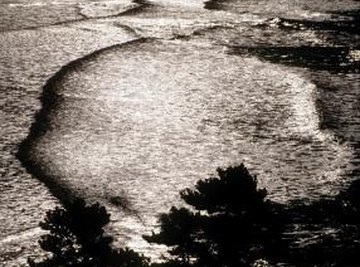
      Discuss the actual mechanisms of tides as they appear to a coastal observer. For this you will deal with the "flood current" or flood tide of a rising tide, with waters approaching shore and heading upriver; the "ebb current" or ebb tide of retreating waters; and the "slack water" in between. The high-tide mark comes after the flood current, and the low-tide mark comes after the ebb current.

    • 5

      Demonstrate tidal action. You can do this with a diagram -- one showing the Earth with its tidal bulges and lows in relation to the moon's position. You could also show a video of dramatic tides -- like the massive shifts in eastern Canada's Bay of Fundy, which experiences the biggest tidal differences anywhere. Head down to a coastline or estuary if you have that access to show the difference between high and low tides.

Related Searches:

References

Resources

  • Photo Credit the coast image by timur1970 from Fotolia.com moon image by Sebastian Glapinski from Fotolia.com low tide image by Liz Van Steenburgh from Fotolia.com

Comments

You May Also Like

  • How to Explain Phases of the Moon & Tides to Children

    The appearance of the moon changes each month, which is known as phases of the moon. During the course of the month,...

  • The Differences Between Neap Tides

    The Earth's oceans form a dynamic system of tides. These tidal movements continuously change in size and intensity. Neap and spring tides...

  • Phases of the Moon & Tides

    The moon is a reliable predictor of terrestrial phenomenon, ranging from the seasons to the flow of the tide. When it comes...

  • Lessons on Tides

    Tides rise and retreat twice daily at predictable times and to predictable levels. Waves can be calm enough to wade in, steady...

  • How to Explore Tide Pools With Kids

    Exploring tide pools with kids can be exciting and fun. Tide pools form when water fills rocky areas with sea water. Tide...

  • Difference in Tidal Waves & Tsunamis

    The terms "tsunami" and "tidal wave" are often used interchangeably to refer to large, destructive waves. However, each refers to a very...

  • How to Explain the War to Your Children

    The war is a difficult thing to try to explain to your children, and it takes patience and some concerted effort on...

  • What Causes the Oceans' Tides?

    There are several forces of gravity that cause ocean tides. Tides are periodic rises and falls of bodies of water. These forces...

  • The Difference Between Spring & Neap Tides

    Tides are the up and down movement of the oceans across land. Two of our sky's most dominate features, the sun and...

  • How to Calculate High Tide Times

    If you're planning any activities near the coast, it is essential that you know at what times the high tides are coming....

  • Learning About Tides for Kids

    When visiting the beach, curious children may ask why the ocean rises so high at one point of the day and then...

  • Types of Ocean Tides

    Types of Ocean Tides. Tides are the result of the moon's gravitational pull on the Earth. This pull results in a slight...

  • How to Understand Tides

    Tides are the periodic rise and fall in the levels of surface water in oceans. Major lakes like the Great Lakes, also...

  • What Determines Tides?

    The tides are one of the most predictable forces on the planet. The cycle of high and low tides is so uniform...

  • The Four Different Types of Tides

    The Four Different Types of Tides. Many people of all different interests and ages enjoy learning about ocean tides. Kids may learn...

  • Moon & Sun Effects on Tides

    The sea level in Earth's oceans rises and falls twice per day. These times of high and low water are referred to...

  • About Ocean Tides

    Seawater rises and falls every day, creating what are called tides. Tides effect the current of the ocean, and knowing the timing...

  • High Tides & Moon Phases

    The gravitational forces of the moon, Earth and sun affect the ocean tides. Each day, four different tides occur---two high tides and...

  • How Do Ocean Currents Move?

    Ocean currents are propelled by various forces. Such forces can include the wind, tidal patterns due to the gravitational pull from the...

  • How to Explain Halloween to Children

    Halloween is lots of fun for kids - mostly because it usually involves getting dressed up and eating candy. There's more to...

Related Ads

Featured