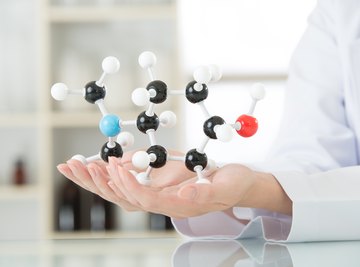
You have by this time most likely seen a few chemical formulas and some kind of representation of the associated molecular structures. For example, the simple molecule carbon dioxide, or CO2, can be represented as a carbon atom joined to two oxygen atoms by junctions called double bonds: O=C=O.
Carbon dioxide, like a lot of compounds in nature, comes in only one form or shape. That is, given a molecular formula like C3H3O3, you would be able to associate it with a unique three-dimensional structure, that of the important metabolic compound pyruvate.
Some formulas, though, give rise to more than one spatial arrangement. Compounds with the same molecular formula but different shapes are called isomers, and because these are so plentiful in the world of hydrocarbons, learning to predict how many isomers a kind of molecule called an alkane can have is a great place to learn about these tricky compounds.
What Are Isomers?
Isomers come in two basic types. Stereoisomers are isomers that differ in their spatial arrangements but have their bonds in the same places.
If this sounds like a contradiction, imagine molecules that are mirror images; these can't be superimposed directly on each other, so they're different, yet the bonds between their respective atoms are in corresponding places. An example is the two forms of the amino acid alanine. These are called D-alanine and L-alanine, loosely meaning "right" and "left."
Structural isomers are isomers in which the bonding sequence of the atoms is different. Unlike the case with stereoisomers, this can result in completely different compounds (as with butane and 2-methylpropane, both of which have the formula C4H10) or in closely related species (such as very large alkanes with small branches).
Branch isomers are a kind of structural isomer found in organic molecules (i.e., those that contain carbon). Carbon can bind to other carbon atoms in addition to bonding to hydrogen atoms, so once a carbon "chain" bordered by a hydrogen atom chain grows long enough for the atoms to move more freely in space, secondary carbon chains may appear at one or more points from one end. As you might expect, this significantly affects the chemical behavior of these molecules.
What Are Alkanes?
Alkanes are compounds containing only carbon and hydrogen atoms joined in single bonds. Since each carbon atom can form four bonds, the door is open to a wealth of isomers within this class of organic compounds, found in abundance in fossil fuels.
The simplest alkane is methane (CH4), followed by ethane (C2H6) and propane (C3H8). In fact, the formula for all alkanes is CnH2n + 2.
You have already seen that butane (C4H10) has an isomer, 2-methylpentane. These are the only two isomers of this molecule. C5H10, on the other hand, has three isomers, while C6H14 has nine. There is no "number of chain isomers formula" for alkanes, and the number quickly grows cumbersome (for example, decane, or C10H22, has a whopping 75 isomers). Instead, you should be able to construct a few of them given a particular alkane formula.
Isomer Combination Formula Calculator
For an example of a program that acts as a combination generator for isomers so that you can see their respective physical structure in space, see the Resources.
Note that if you try to input a formula for which there is no isomer, the program quickly returns a null result. You may want to experiment with drawing some of these prospective compounds to see why they are impossible to generate, given basic chemical bonding principles.
References
Resources
About the Author
Kevin Beck holds a bachelor's degree in physics with minors in math and chemistry from the University of Vermont. Formerly with ScienceBlogs.com and the editor of "Run Strong," he has written for Runner's World, Men's Fitness, Competitor, and a variety of other publications. More about Kevin and links to his professional work can be found at www.kemibe.com.