How to Work a Telestar Meade Telescope

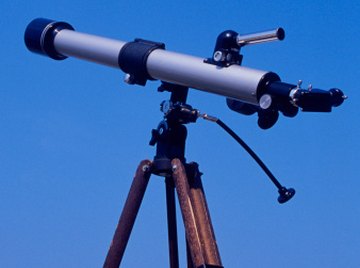
The Meade Telestar refractor telescope magnifies the wonders of the night sky. It uses a lens-based optical design to gather and focus the light from distant objects, such as the moon, planets and stars. Meade provides 25mm and 9mm eyepieces, which produce 28X and 78X magnification, respectively. The included 2X Barlow lens effectively doubles the magnifying power of the telescope, giving you 56X power with the 25mm eyepiece and 156X with the 9mm. The Telestar refractor sits atop an altitude/azimuth mount, which simplifies the process of locating and tracking astronomical objects.

Things You'll Need

  • Altitude/azimuth tripod mount
  • 25mm eyepiece
  • 9mm eyepiece
Show More

Instructions

    • 1

      Find a dark observing site. Street lights, porch lights and other types of light pollution reduce your eye's ability to see faint detail in astronomical objects. Observing sites located in rural areas, away from the light pollution found in large cities, offer the best conditions for astronomy.

    • 2

      Lay the tripod flat on the ground. Loosen the thumbscrew on each of the three legs. Extend each leg to the same length and tighten the thumbscrews. Stand the tripod upright.

    • 3

      Loosen the lock knob on the telescope mounting bracket. Slide the telescope into the mounting bracket and tighten the lock knob.

    • 4

      Aim the telescope at an astronomical object. Pick a bright object, such as the moon or a star, if you've never used a telescope before. Move the telescope left or right and up or down by pushing the optical tube. With the telescope pointed in the general direction of the target, look through the finder scope. Fine tune the telescope's orientation to center the object in the finder scope's field of view.

    • 5

      Insert the 25mm eyepiece into the focuser. Look through the eyepiece and adjust the focus knob until the object appears sharp in the eyepiece. Observe the object at 28X before moving on to higher magnifications.

    • 6

      Remove the 25mm eyepiece and insert the 9mm eyepiece. Look through the eyepiece and focus the telescope. Observe the object at 78X magnification before moving on to higher powers.

    • 7

      Remove the 9mm eyepiece. Insert the 2X Barlow lens, and then insert the 9mm eyepiece into the Barlow lens. Look through the eyepiece and turn the focus knob to adjust focus.

Tips & Warnings

  • Use magnifications below 100X to observe large star clusters and nebula. Reserve higher magnifications for the moon and planets. You can adjust the telescope's orientation periodically while observing an object for an extended period to compensate for the Earth's rotation.

  • Looking at the sun through a telescope will permanently damage your vision.

Related Searches:

References

Comments

You May Also Like

  • How to Use a Meade Telescope

    Telescopes let you study the night sky in incredible detail. You can use a telescope to observe the moon, planets and distant...

  • How to Use a Meade AutoStar Telescope

    The Meade Autostar Telescope utilizes a computer control mechanism to enhance the functions of the telescope. Autostar provides a computer connection that...

  • How to Operate a Meade 105 ETX Telescope

    The night sky can be interesting to study with your naked eye, but using a telescope to look at stars and planets...

  • How to Collimate My Meade Refractor

    A refractor telescope uses a convex lens to capture and magnify light, projecting images directly onto an optical objective for viewing. They...

  • How to Use a Telescope

    If you or your child is interested in astronomy, you will want to purchase a telescope sooner or later. There are basically...

  • How to Use a Vivitar Telescope

    A telescope lets you observe celestial objects in the night sky in extraordinary detail. Vivitar manufactures refractor telescopes that include everything you...

  • How to Use the Bushnell Telescope 78-9512

    The Bushnell 78-9512 Deep Space Series telescope uses a two-lens, achromatic optical design to reveal extraordinary detail in the night sky. It...

  • Eyepieces for Telescopes

    Discussion of the varieties of telescope eyepieces available. Learn how to choose the right eyepiece for you in this free home astronomy...

  • The Best 25X100 Binoculars

    The Best 25X100 Binoculars. Binoculars, an excellent way to get close up views that the human eye could never normally see, are...

  • How to Make Your Bushnell Reflecting Telescope Work

    Amateur astronomy is an intellectually challenging hobby. On occasion, amateur astronomers make discoveries before the professionals do. Getting started with a new...

  • How to Change the Oxygen Sensor in a Saturn

    A rough running engine in a Saturn could be caused by one of several problems. It could require a tune-up that would...

  • How to Focus a Meade LX200 GPS Telescope

    Owning a Meade LX200 GPS telescope will give you the opportunity to view magnificent sights in the night sky, including planets, nebulae,...

  • How to Track the Altitude & Azimuth of the Moon

    Astronomers track the altitude and azimuth of the Moon and other celestial objects in the sky to predict their future position. Modern...

  • How to Put a Meade Telescope Together

    Meade telescopes are made for celestial observation. Meade produces a variety of different powered scopes with a range of eyepieces and accessories....

  • How to Focus a Telescope

    A telescope must be focused to show a proper image. An out-of-focus telescope will show blurs or nothing at all. The first...

Related Ads

Featured