
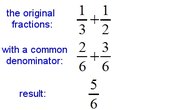
To evaluate fractions, you need to know some basic operations such as simplification, addition, subtraction, multiplication and division. A fraction is a part of a whole. It is written "a/b," where "a" is called the numerator and "b" is called the denominator. It means that you have divided the whole into "b" parts (like "b" slices of pie), and you have "a" of them. Keeping this concept in mind will help you learn to evaluate fractions.
Reducing Fractions and Converting to Decimals
Find the largest number that evenly divides both the numerator and denominator. This number is their greatest common divisor. You want the numerator and denominator to be as small as possible without changing the value of the fraction. This reduces the fraction to lowest terms.
Divide both the numerator and denominator by their greatest common divisor. This does not change the value of the fraction. Given the fraction 2/8, for example, divide the numerator and denominator by 2 to get 1/4. This is equivalent to 2/8 but reduced to lowest terms. Reduce 5/15 to lowest terms by dividing both the numerator and denominator by 5 to get 1/3.
Divide the numerator by the denominator to get a decimal form of the fraction. For example, 2/4 translates to 0.25, and 1/3 equals 0.33.
Addition and Subtraction
Add the numerators of fractions that have the same denominator. The sum will take the same denominator. For example, 2/8 + 3/8 = 5/8.
Follow a multistep process when the denominators are not the same. Manipulate the fractions so they have the same denominator. Then add or subtract as required. For example, consider adding 2/6 and 1/8.
Reduce both fractions to lowest terms. Using the example, 2/6 + 1/8 = 1/3 + 1/8.
Look for the smallest number that is evenly divided by the denominator of either fraction. This is the least common multiple. Twenty-four is the least common multiple of 8 and 3 because 3 x 8 = 24 and 8 x 3 = 24.
Expand the fractions so that they have the same denominator, which is the least common multiple. Multiply 1/3 by 8/8 to get 8/24. Multiply 1/8 by 3/3 to get 3/24.
Add or subtract as required: 1/8 + 2/6 = 1/8 + 1/3 = 3/24 + 8/24 = 11/24. Do the same for subtraction. For example, 3/5 - 2/6 = 3/5 - 1/3 = 9/15 - 5/15 = 4/15.
Multiplication and Division
Multiply a fraction with a whole number by multiplying only the numerator. For example, 5 x 1/8 = 5/8.
Multiply a fraction with another fraction by multiplying the numerators together and the denominators together. For example, 3/8 x 2/5 = 6/40 = 3/20.
Follow the same procedure when you divide, except first flip the fraction you are dividing by. For example: 3/8 ÷ 2/5 = 3/8 x 5/2 = 15/16.
References
About the Author
Ariel Balter started out writing, editing and typesetting, changed gears for a stint in the building trades, then returned to school and earned a PhD in physics. Since that time, Balter has been a professional scientist and teacher. He has a vast area of expertise including cooking, organic gardening, green living, green building trades and many areas of science and technology.
Photo Credits
Jupiterimages/Stockbyte/Getty Images