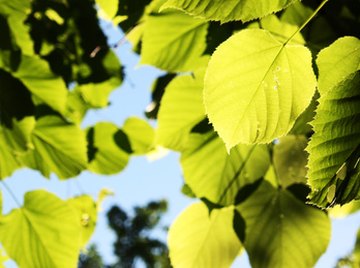
The science of photosynthesis can be difficult for students, especially younger students, to understand without hands-on activities allowing them to see what they are being taught. Lab experiments that teach the fundamentals of photosynthesis can be conducted with children as young as elementary school. These experiments are designed to supplement the more theoretical elements of photosynthesis since they illustrate the effects of sunlight deprivation on plants, rather than explicitly showing how plants convert sunlight into food.
Sunlight Deprivation
After explaining the basics of photosynthesis, how plants make sugar out of sunlight, you can illustrate the effects of sunlight deprivation on plants. Using bean sprouts or another type of inexpensive and fast-growing plant, give each child two plants potted in small paper cups. Each child places one plant on a sunny windowsill and the other in a closet with no windows. Each plant is given equal soil and watered over the course of a week. At the end of the week, have the children compare the plants. The droopy sun-deprived plant demonstrates how the inability to photosynthesize harms plants.
Experiments with Chlorophyll
Fundamental to a lesson about photosynthesis is an explanation of chlorophyll and the vital role it plans in helping plants harness the power of the sun. A simple lab experiment uses simple materials: scissors, glass jars, coffee filters, and acetone. Students cut up two or three large leaves (which need not be green). Mix the leaf pieces in acetone and let sit for a day. Cut the coffee filters into strips and dip one end into the acetone. As the plant chemicals released by the acetone move up the filter paper, a strip of green becomes visible, this is the chlorophyll.
The Chemical Reactions of Photosynthesis
Once students understand the fundamentals of photosynthesis, educators can lead them through a simple experiment where they can witness first-hand the one of the chemical reactions of photosynthesis. Using small plants purchased at an aquarium store, student place samples of the plant in water-filled test tubes which they cork. Over the course of half an hour tiny air bubbles will develop on the walls of the test tube. These bubbles are evidence of the chemical reaction whereby plants covert carbon dioxide and water (hydrogen) into carbohydrates (food).
About the Author
Based in Seattle, Antonia Lawrence has been writing and editing since 2007. Lawrence has worked and traveled extensively in both Europe and Asia. She holds a Bachelor of Arts in history and French language from Agnes Scott College and a Master of Business Administration from the University of Florida.
Photo Credits
Green leaves image by BlackFox from Fotolia.com