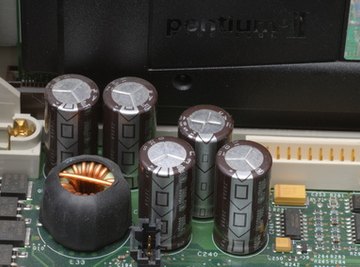
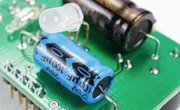
Electrolytic capacitors derive a large part of their capacitance from the formation of a gaseous layer on one plate when proper polarity is applied. Capacitance (C) is the is the magnitude of charge (Q) on each plate divided by the voltage (V) applied to the plates: C=Q/V. This gaseous layer and greater dielectric effect gives an electrolytic capacitor a much larger capacitance by volume than other types of capacitors can achieve.
Size
The most common type of electrolytic capacitor is the tantalum capacitor. Others are broken down by gas type or dielectric paste used, with aluminum electrolytic and polypyrrole being typical. In each case, the capacitance available in an electrolytic capacitor could only be achieved by a non-electrolytic capacitor (such as paper or mica capacitors) of a much larger size.
Capacitance
Electrolytic capacitors have a greater capacitance per volume than any other type of capacitor. Because of this size difference, few non-electrolytic capacitors are made with capacitance greater than 10 microfarad (uF).
Uses
Because of their higher capacitance values, electrolytic capacitors are most often used in lower-frequency applications such as in power supply filters. The high capacitance values typically associated with electrolytic capacitors act as shorts or low impedance lines for RF (Radio Frequency) and higher-frequency applications.
Applications
Because of their construction and polarity-sensitive operation, electrolytic capacitors require more careful use than other capacitors. If installed improperly (reverse polarized), electrolytic capacitors will not achieve correct capacitance and may build internal gas pressure, leading to an (minor) explosion. Electrolytic capacitors are also more temperature sensitive than other types of capacitors. Before using an electrolytic capacitor, verify it is suitable for your expected temperature conditions.
Properly chosen and installed electrolytic capacitors are a useful component in the circuit designer's inventory, providing high capacitance for low size (circuit board "footprint") and cost relative to other types of capacitors.
References
About the Author
Chris Donahue is an electrical engineer living in the Dallas area. He has worked on defense projects, semiconductor process equipment, instrumentation and is currently in water utilities. He earned his Registered Massage Therapist (RMT) standing in Texas in 1999.
Photo Credits
pc due image by Renato Francia from Fotolia.com