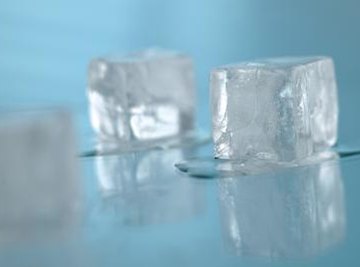
As you sit outside on a hot day, you watch the ice in your glass of water slowly melt. Later, you dump some ice from a cooler into the sink and turn on the water to melt the ice. You can’t always use that trick, however. On a cold winter day, for example, you can’t pour a glass of water on your car’s ice-covered windshield; that will not melt the ice. Water melts ice, but only under certain conditions.
The Melting Process
Melting, by definition, is the process of changing a substance from a solid phase to a liquid phase. The process of melting is an endothermic process, meaning that heat energy must be absorbed for it to occur. This heat energy comes from surroundings that have more energy and a higher temperature than the substance to be melted. It is only through a temperature difference that heat energy is transferred, which will then cause one substance to melt (or at least increase in temperature) while the surroundings decrease in temperature. The melting temperature (called the melting point) is different for different substances.
When Does Water Melt Ice?
Most of us are familiar the melting point of ice: 0 degrees Celsius or 32 degrees Fahrenheit. If the temperature of ice is below this number, it will stay solid; if the temperature of the ice is increased above this number, the ice changes to liquid water. If ice comes into contact with water, we know the ice must be below 0 degrees Celsius and the water must be higher than 0 degrees Celsius. Because of the difference in temperatures, heat transfer will occur. The result will be that the water will decrease in temperature and the ice will increase in temperature.
Will Water Always Melt Ice?
This depends on how much ice you started with, the initial temperature of the ice, how much water was used and the initial temperature of the water. If you put a few ice cubes into a glass of warm water, you should already know the result: the water will cool down and the ice cubes will melt. In this case, there is enough water at a high enough starting temperature to not only increase the temperature of the ice cubes, but also melt them.
When Will Water Not Melt Ice?
It should now make sense that not all instances of adding water will melt ice. Even though the water is at a higher temperature than the ice, if there is significantly more ice than water, or if the temperature of the ice is very low to start with, then not enough heat energy will be transferred to increase the temperature of the ice and melt it, too.
Summary
Water melts ice because it is at a higher temperature than the ice, so heat energy is transferred from the water to the ice. Since the scientific principle at work here is the idea of heat transfer, it is not necessary that water be used to melt ice. Any substance (solid, liquid or gas) that is at a higher temperature than the ice will be able to transfer heat energy to melt the ice.
References
- Chemistry: The Central Science; Theodore L. Brown, H. Eugene LeMay, Jr. and Bruce E. Bursten; 2003
About the Author
Amanda Hoff is a senior at Missouri State University in Springfield, Mo., where she is majoring in broadcast journalism. A writer since the age of 13, her work has been featured in several publications, and she has won more than 20 awards for stories she has written for them.
Photo Credits
Comstock/Comstock/Getty Images