
Although they are a type of algae, seaweeds look like plants and they "breathe" by photosynthesizing carbon dioxide to oxygen, just as terrestrial plants do. Marine animals depend on this oxygen as well as on the seaweeds themselves, which are an important part of the food chain.
Seaweed facts don't end there, though. Humans also eat seaweed; these marine algae form a large part of the diet in coastal areas and supply a number of beneficial nutrients unavailable elsewhere.
Seaweed Facts: There Are Three Main Types
One of the lesser known seaweed facts is that "seaweed" actually refers to approximately 10,000 different varieties of seaweed that grow in the world's saltwater environments. This includes three main types: green, brown and red.
All three contain chlorophyll -- which gives terrestrial plants their green pigmentation -- but brown and red seaweeds contain other pigmentation that overrides the green color of chlorophyll. Green seaweeds prefer shallow water and warm, tropical climates, and unlike their microscopic counterparts -- blue-green algae -- they live only in salt water, as do brown and red seaweeds. Brown seaweeds are much bigger than the green variety and live at greater depths, while red seaweeds can grow in cold water that is either shallow or deep.
All seaweeds need sunlight to survive, so they tend to grow only at the edges of the oceans.
Read more facts about seaweed.
Kelp vs Seaweed Definition
Many believe that kelp and seaweed are synonymous, which isn't entirely incorrect. Kelp is actually a specific type of brown seaweed that grow to very large sizes. Seaweed, as we said earlier, is a general term that refers to over 10,000 different species of different sizes and colors. Kelp is almost always large and is always a type of brown seaweed (although the actual color of kelp can vary, despite it always being a type of brown seaweed).
Read more facts about sea kelp.
No Roots or Flowers
Only a few seaweed varieties are able to survive free-floating in the ocean; most have to be attached to something. Large seaweeds, such as kelp, have root-like appendages called holdfasts that allow them to hold firmly to a rock. They grow in colonies to form underwater forests, which provide shelter and sustenance for a variety of organisms.
No seaweeds have roots, and even though they look like plants, seaweeds don't have flowers either. Some varieties, such as sea lettuce, have fronds that wave with the tides, while others have branches with air bladders at the tips to keep the branches near the surface, where sunlight is plentiful.
Sea Vegetables
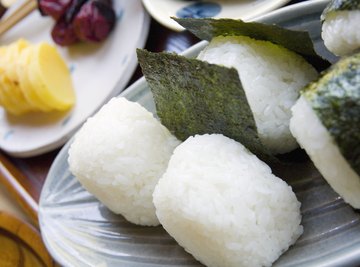
Seaweeds aren't really weeds; they are important food sources for marine animals as well as humans, and many coastal dwellers prefer to call them "sea vegetables." One particular red seaweed -- Porphyra -- is known as nori in Japan and is one of the main ingredients in sushi. Other popular edible seaweeds include wakame and kelp -- or kombu -- which are both brown seaweed varieties harvested and marketed in Japan and elsewhere.
Seaweeds are good sources of potassium, iodine, vitamins and other trace elements. Vegetable gelatin from certain red seaweed species -- called agar -- offers an important medium for culturing bacteria and fungi for medical purposes.
How Seaweeds Reproduce
Seaweeds are a complex group of organisms, and they can reproduce in a number of ways. Some reproduce asexually, while more advanced seaweeds might release zoospores that swim off and anchor themselves to a distant rock and begin growing. Other advanced types of seaweed reproduce sexually by forming sex cells -- gametes -- that have to fuse before growth can begin.
These seaweeds secrete sex pheromones to attract gametes, much as higher organisms do. Seaweeds are adept at reproduction, and many species are invasive. Sargassum muticum, or wireweed, is especially prolific outside its natural habitat off the coast of Japan. In Irish waters, it creates an obstruction for swimmers and boaters and blocks light to other organisms.
References
About the Author
Chris Deziel holds a Bachelor's degree in physics and a Master's degree in Humanities, He has taught science, math and English at the university level, both in his native Canada and in Japan. He began writing online in 2010, offering information in scientific, cultural and practical topics. His writing covers science, math and home improvement and design, as well as religion and the oriental healing arts.
Photo Credits
didi/amana images/Getty Images