Things You'll Need
Solar panels
Wiring
Wire strippers
Electrical tape
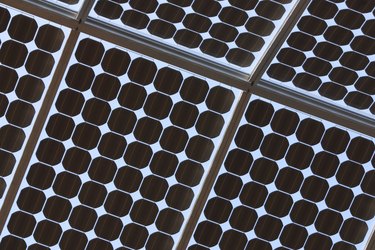
In arranging solar panels, you have two options for modifying the power output, according the Ohm's law. You can either wire multiple panels in series to increase voltage, with current (amps) remaining the same as any one panel, or wire the panels in parallel to increase current, with the voltage output remaining the same as any one panel. If the wiring has to travel a large distance, increasing voltage is a better option. Either way, according to Ohm's law, you will get the same ultimate power output (P=VI).
Step 1
Mount your solar panels so that they face south (or north if located in the southern hemisphere) at an angle that matches your latitude if keeping the panels fixed. Make sure that the site selected does not receive shade throughout the day.
Video of the Day
Step 2
Identify and isolate the two power-output wires from each panel. One will be labeled positive (+) and the other negative (-).
Step 3
Connect together all of the positive output cables using a single length of shielded wire. Start at the end of your array, farthest from where the charge controller is situated, and connect one end of the wire to the positive terminal on the farthest panel. Strip a small amount of shielding away from the wire to connect the positive output wires of all the subsequent panels to it then cover all exposed wiring with a liberal amount of electrical tape.
Step 4
Connect a single wire in the same fashion as in step 3 but to the negative wires. You should be left with two wires connecting all the panels, one positive and one negative. Connect these two wires to the corresponding terminals on your charge controller. Wiring the panels in parallel, like this, will output the voltage of any one panel, but will add the current output together.
Tip
If you have 10 panels each outputting 24 volts and 4 amps, wired in parallel, your total output will measure at 24 volts, and 40 amps. If wired in series you will output 240 volts at 4 amps. Both arrangements will theoretically output 960 watts of power. Increasing voltage means you can use smaller-gauged wires, which are cheaper, and will allow you to transmit power over farther distances. Increasing current will mean that larger-gauged wires will need to be used, and will most likely be less efficient because of losses, but might mean that the voltage being sent will not need to be converted, if requiring 24 volt power.
Warning
Solar panels can output enough power to kill. Handle with extreme care.
Video of the Day